With grant clock ticking, Beecher Building Committee advances plan for new school construction
Plan calls for demolition of Beecher Road School and construction of a new building on the property, including expansion of Pre-K program

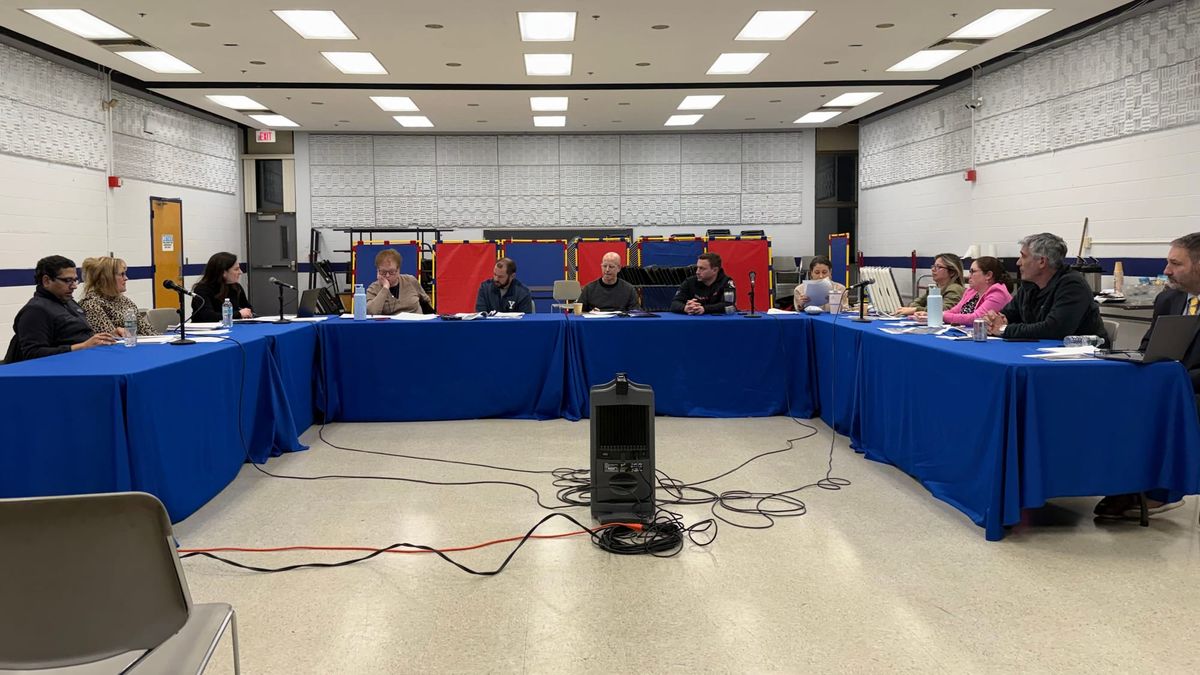
The Town's Beecher Infrastructure Upgrade Building Committee (BIUBC) met February 26 in joint session with the Woodbridge Board of Education (WBOE) to discuss and act upon plans for school facility upgrades. The meeting was held in-person at Beecher Road School's South Assembly Room with one WBOE member attending remotely; no WGATV recording was made of this joint meeting.
After approval of BIUBC meeting minutes, the BOS liaison to the BIUBC, Selectman Maria Madonick, introduced the committee’s consultants and provided an overview of the proposal process for the newly seated WBOE members.
This iteration of the building committee has been developing facility improvement plans for more than two years. In March 2024, the Board of Selectmen approved a revised charge expanding the committee’s responsibilities beyond oversight of a project to repair leaking roofs — primarily over the kindergarten wing — and make grounds improvements that had been initiated by a prior committee (see prior committee charge, p. 7). The current committee consists of five members, with non-voting liaison roles for one member each of the Board of Selectmen and the Board of Finance.
After providing the introductory remarks, Madonick then turned the meeting over to the consultants from Antinozzi & Associates who began their presentation by reviewing the prior project options presented to the Tri-Board meeting that took place in September 2025, as well as subsequent direction to expand Pre-K space received from the Building Committee (see previous meeting summary).
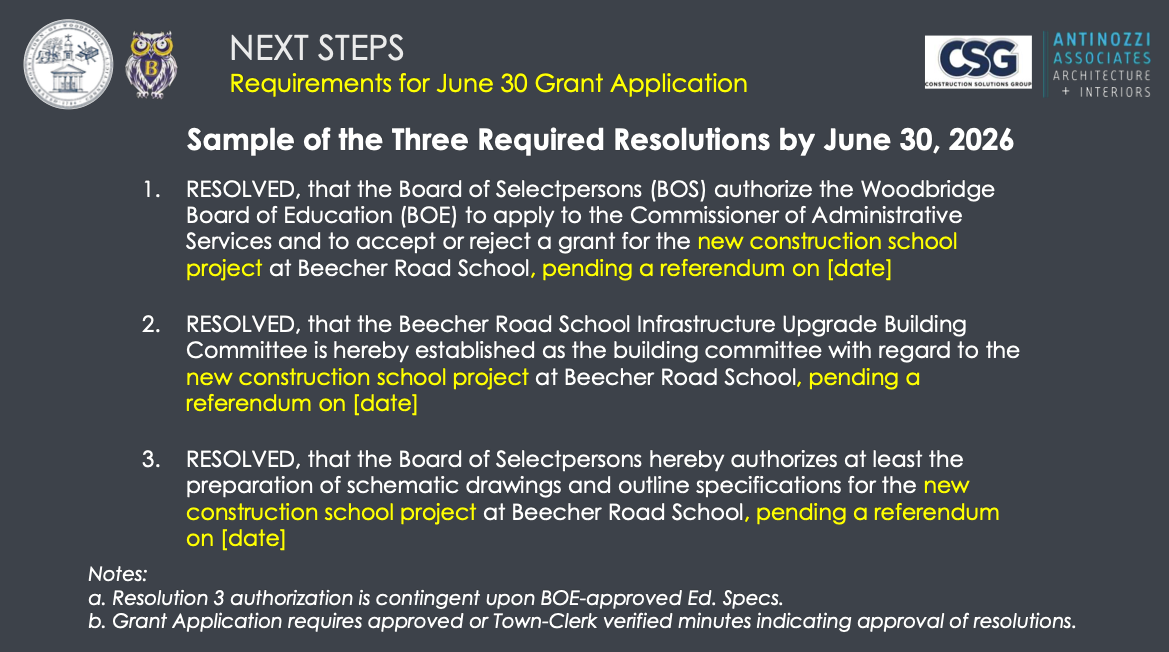
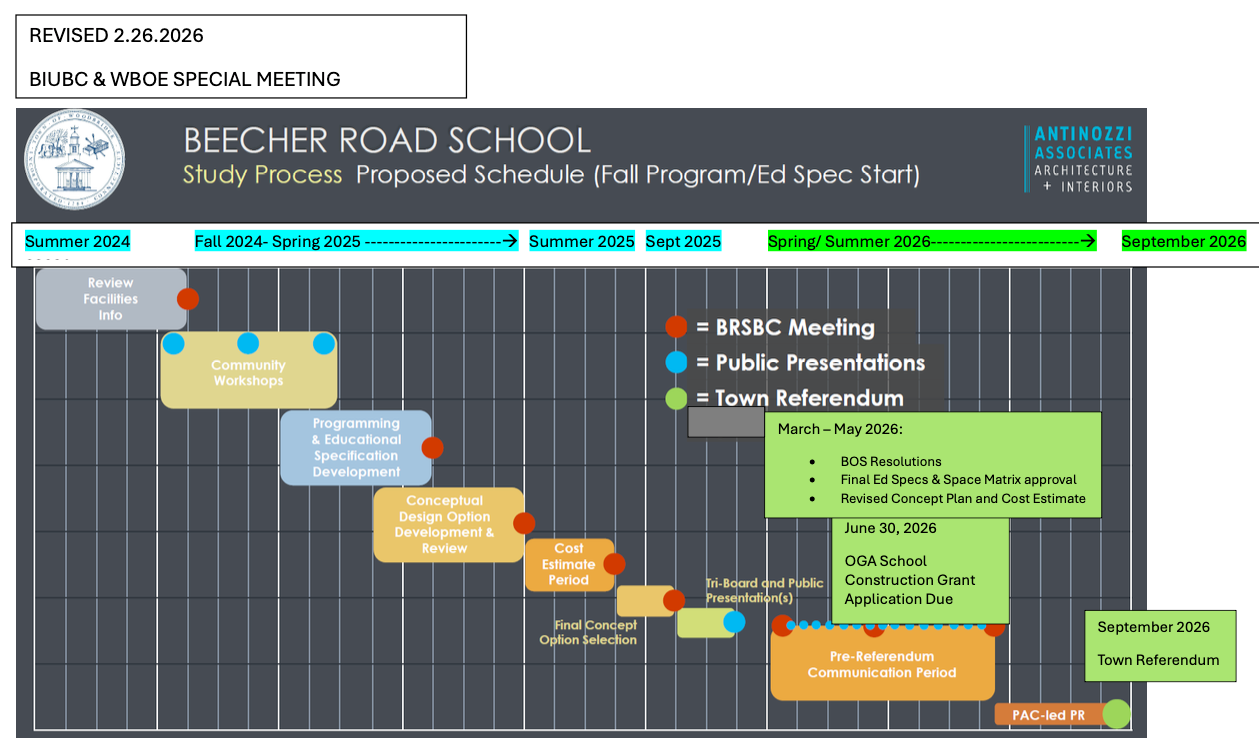
Following that presentation, Madonick outlined the procedural steps required if the town intends to meet the June 30, 2026 state grant submission deadline. She noted that required approvals include Board of Education action, Board of Selectmen review, Board of Finance consideration, and ultimately voter authorization (see sample motions and timeline from the presentation, below).
Option D3 is detailed
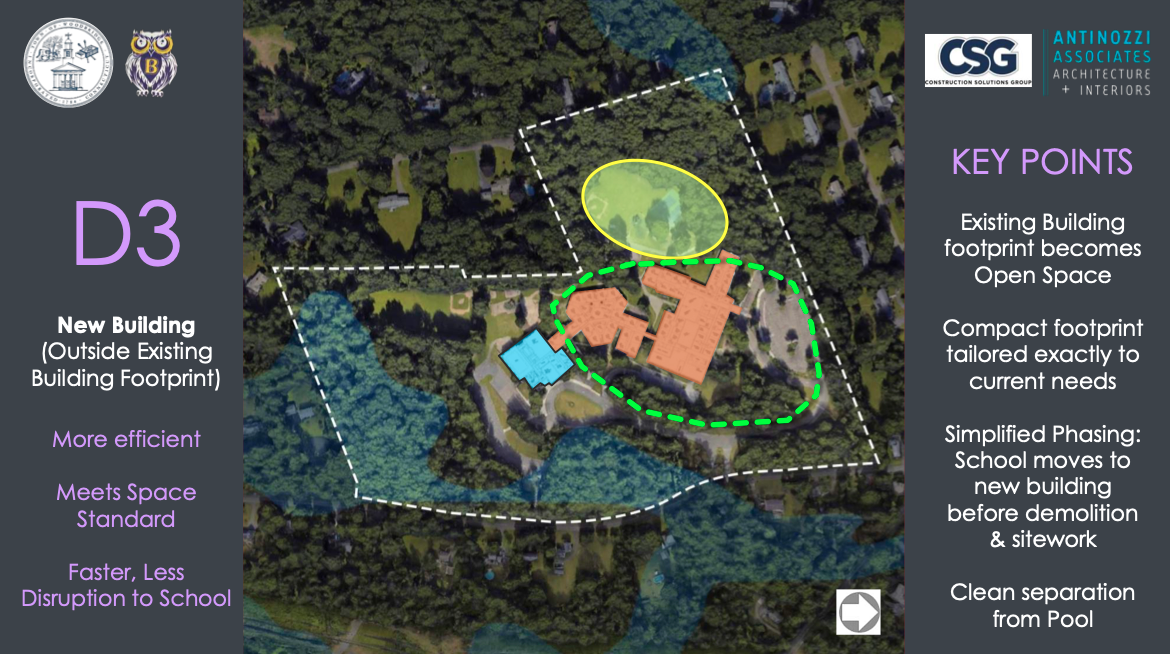
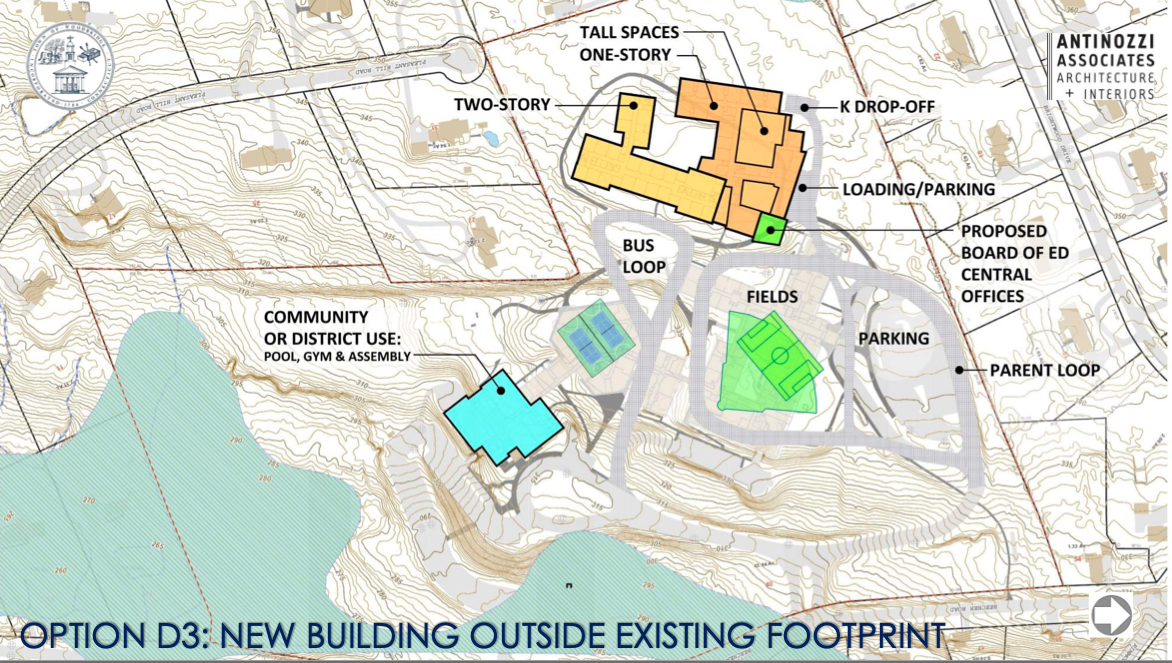
As the review of options proceeded, one configuration — labeled D3 — emerged as the consensus choice. As previously described, Option D3 entails construction of a new school outside the footprint of the existing building, followed by demolition of the current Beecher Road School facilities. Under that plan, the portion of the property presently occupied by the school would become “open space” (see presentation slides for location details).
At the February 26 meeting, the revised total project cost for Option D3 was presented as $108.98 million. Madonick led the group through a discussion of the state grants that may be available to offset these costs, resulting in what was described as about $57 million in costs remaining to be borrowed by the Town of Woodbridge to pay for the project. However, it was noted that at this stage, all costs are estimates only.
Preschool expansion: Discussion of demand and design
A substantial portion of the discussion centered on the proposed expansion of the district’s Pre-K program. Currently, Beecher operates two half-day Pre-K sessions sharing a single classroom, primarily serving students receiving early intervention and preschool special education services under Connecticut’s Birth to Three and special education programs, alongside tuition-paying typical peers.
Under the expanded D3 configuration, the district would construct space for six Pre-K classrooms. WBOE members asked questions about this aspect of the proposed building project, including whether community demand exists to support six classrooms, whether the expanded program would operate full day, if tuition would be charged, and whether projected enrollment justifies the scale of this expansion. Discussion indicated that if tuition were set at or below prevailing regional preschool rates, there may be sufficient interest to fill the expanded capacity. However, members acknowledged that decisions regarding how many Pre-K classrooms to build likely must precede certainty about utilization.
Operating costs not yet modeled
During discussion, a Building Committee member asked whether the costs associated with operating six Pre-K classrooms — including teacher salaries and support staff — had been modeled as part of the consultants’ scope of work. The response indicated that operating costs are not being examined at this time. The current consultant engagement focuses on facility design and capital cost estimates in support of a potential state grant application.
It was noted by Superintendent Chris Montini that tuition-paying students might offset some portion of program costs, though it remains to be seen whether tuition revenue would cover the full expense of additional staffing and program operations. Any ongoing operating costs would ultimately be addressed through the district’s annual operational budget process.
Cost framing: Maintenance and lifecycle considerations
Further discussion reflected the view that alternative options that were considered by the Building Committee would not ultimately prove less expensive. Participants referenced projections suggesting that maintaining the existing building over the next 20–30 years, undertaking major space reconfigurations such as moving classroom walls, and addressing accessibility issues by bringing currently grandfathered areas into full ADA compliance could cumulatively approach the magnitude of a more comprehensive building project.
At the same time, the question of lifecycle costs for a new facility was also raised by a Building Committee member. It was noted that any newly constructed building would eventually face its own maintenance and capital replacement needs. In that framing, a new building may represent only a reset in the timeline of major expenditures rather than a permanent solution. A comparative cost analysis reflecting both perspectives has not yet been publicly presented.
Condition of the existing building
During discussion, the existing Beecher Road School facility was described as being in need of significant enhancement and modernization. The current deliberations occur approximately ten years after completion of the 2015–2016 Beecher renovation project, a $13.3 million effort approved by voters to upgrade core systems including heating, ventilation, lighting, and security.
At the time, the 2015-2016 renovation was presented to voters as a modernization effort projected to extend the useful life of key systems for approximately 20 years. The bonded debt undertaken to finance that project is not scheduled to be retired until 2036. Even if the building were to be demolished and replaced, the remaining debt would continue to be repaid according to its existing schedule, unless refinanced as part of a future borrowing package under prevailing market conditions.
No detailed comparison between the scope of the prior renovation and the deficiencies now cited was presented during the February 26 joint session.
Proposed revision of ‘Educational Specifications’
The Building Committee, through its BOS liaison, also recommended modifying the district’s Educational Specifications document to reflect the intention to operate an expanded Pre-K program. The Educational Specifications document is a required component of any state school construction grant submission and must establish the educational basis and programmatic need for the proposed facility.
The specific language of the proposed modification was not available in the publicly posted Board of Education materials at press time.
WBOE Chairman Steven Lawrence stated that it is his intention to place items discussed at the joint meeting — including potential Educational Specifications revisions — on the agenda for the Board’s regular March meeting for formal action. No action was taken by the WBOE at the February 26 joint session.
Formal motion to choose option D3 is approved
After discussion, a motion was made and seconded to proceed with Option D3 expanded to include six Pre-K classrooms. The motion was approved unanimously by the Building Committee. With this vote, the committee identified a single project configuration as its working proposal moving forward. Revised cost estimates for D3 reflecting the expanded scope have not yet been publicly presented.
Advocacy and referendum boundaries
During discussion of next steps, Madonick announced that a group of parents with children who attend BRS was prepared to file paperwork to establish an education political action committee (PAC) with the Town Clerk in support of the project.
She also noted that once a referendum date is formally set, members of boards and commissions are prohibited from advocating for or against the referendum question.
Under Connecticut General Statutes § 9-369b, when a municipality prepares explanatory text or other materials concerning a local question, those materials “shall not advocate either the approval or disapproval of the proposal.” The statute governs the use of public funds and requires that any official explanatory text be neutral in tone and informational in content.
While the law specifically addresses municipal communications prepared with public resources, it reflects a broader principle in Connecticut election law: once a referendum is formally set, public bodies and officials acting in their official capacities may not use municipal resources to promote or oppose the question.
The formation of a PAC would allow advocacy efforts to proceed outside formal municipal channels once the date for the referendum is established and the question is pending before voters. Under Connecticut campaign finance law, a political action committee — technically called a “political committee” — organized solely to influence a local referendum, whether to support or oppose a ballot question, must register with the town clerk once it raises or spends $1,000 or more.
Once registered, a PAC may solicit and accept contributions and independently advocate for or against a ballot question, but such advocacy may not use municipal funds, staff time, or official communication channels. It must also file detailed financial reports so voters can see who is funding the advocacy. Additional guidance is available from the State Elections Enforcement Commission (SEEC).