What is Charter Revision?
How the process unfolds, who’s involved, and what happens next
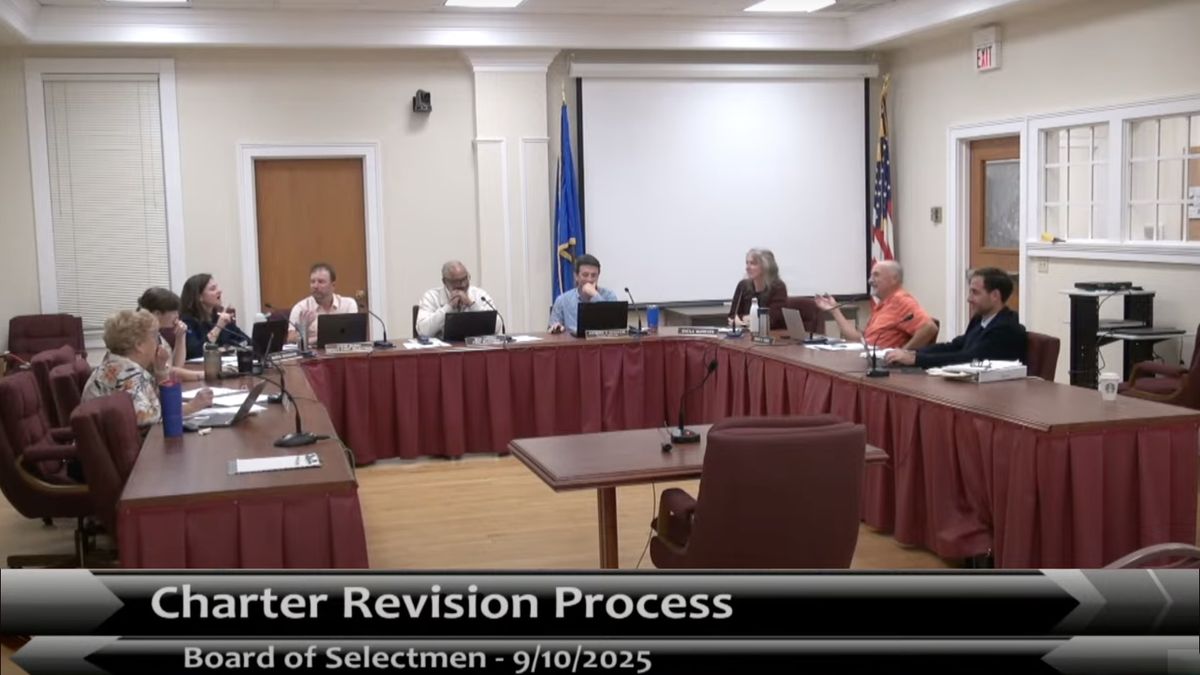
Woodbridge is now considering whether to revise its Town Charter — the governing “constitution” for how our local government works. The idea had already come up during the budget discussions in February, and was most recently an item on the agenda for discussion at the September 10 Board of Selectmen (BOS) meeting.
How the Process Works
Connecticut law sets out a clear, multi-step path for charter revision:
- Board of Selectmen vote: A two-thirds majority of the full board is required to begin the process.
- Commission appointed: Within 30 days of the vote to initiate, the BOS appoints a Charter Revision Commission (CRC) of 5–15 residents, ensuring political balance.
- Public input: The CRC must hold at least two public hearings: one before work begins and one after a draft report is completed.
- Reports to the Board: The CRC submits draft and final reports to the Board of Selectmen, which can hold hearings, make recommendations, and vote to approve or reject the proposed changes.
- Townwide vote: Approved proposals go before voters at either:
- a regular election (simple majority needed) or
- a special election (majority and at least 15% of registered voters). - Implementation: If adopted, the new charter provisions take effect 30 days after the vote (unless a later date is specified).
Details governing charter revision procedures, outlined in Connecticut General Statutes §§ 7-188 through 7-191, define how a town initiates charter revision, appoints a commission, conducts hearings, and prepares questions for voter approval. Because application of these requirements can vary, towns typically rely on their town attorney to guide each step.
In general terms, the process involves an appointing authority— in the case of Woodbridge, this would be the BOS — vote to initiate charter revision, followed within 30 days by the appointment of a Charter Revision Commission (CRC) of 5 to 15 members. At the time of appointment, the appointing authority typically adopts a resolution outlining the topics it wishes the CRC to review, sometimes referred to as the “charge.” The CRC must hold at least two public hearings and submit draft and final reports to the BOS, which must include all items listed in its charge.
Once the CRC has completed its work and issues a final report, the BOS then determines whether proposed changes will appear on the ballot at a regular or special election, may decide how questions are worded or separated into individual ballot items, or may reject the commission’s final report entirely, in which case no vote would occur unless residents successfully petition to force a referendum under state law.
The Final Say
Ultimately, the residents of Woodbridge decide whether to adopt any changes to the Town Charter. The BOS may submit the proposed changes as one question or multiple questions on the ballot. The BOS will also choose between two options for sending Charter Revision to the voters; either add the question(s) to the ballot at a regular November election, or set a special election any time of the year.
As outlined above, the options have different thresholds for approval. With 6,113 registered voters (as of May 2025), 15 percent equals approximately 917 “yes” votes needed in a special election for a proposed charter to pass — even if a majority of those voting favor it.
In contrast, at the regular election in November 2023 for example, turnout was 3,304 voters. In that scenario, had there been charter revision questions on that ballot, a simple majority would require just 1,653 or more “yes” votes (assuming everyone turned out for the question).
If a special election drew low turnout, even an enthusiastic majority might struggle to meet the 15 percent threshold to approve.
Next Steps
A timeline for charter revision discussed by the Selectmen at their September meeting sketched out a process beginning in fall 2025, with the commission appointed in October, public hearings held through the winter, and a final report delivered to the BOS by mid-2026. This schedule anticipates a public vote on proposed charter changes during the November 3, 2026 regular election, allowing the revisions to be filed with the Secretary of the State by December 2026. While this proposed sequence meets statutory deadlines, it leaves limited flexibility if the newly elected Board of Selectmen — seated in January 2026 — chooses to weigh-in.
If the timeline were adjusted to begin after the new BOS is seated in January, the process might need to extend to the November 2027 general election instead. This would provide additional time for public education and community participation, aligning the vote with higher turnout typical of regular elections. Or, the Selectmen could choose the special election option and set a date between the November 2026 and 2027 regular elections.
Role of Petitions
Residents also have a statutory path to propose specific topics for charter revision through a petition process described in Connecticut General Statutes § 7-190(b). A petition signed by at least 10 percent of the town’s electors (in Woodbridge, roughly 612 voters) can require that those petitioned recommendations be directed to the Charter Revision Commission (CRC) for consideration. Once such a petition is certified by the Town Clerk, the Board of Selectmen, as the appointing authority, must act to initiate or continue the process and appoint the commission.
While the statute ensures that petitioned items must be considered, it does not clearly define whether petitions may also be used to add new topics after a commission has already been appointed.*
* Editor’s note: This paragraph has been updated to reflect the BOS discussion of charter revision at its October 8, 2025 meeting, including the role and timing of resident petitions in the charter revision process (see meeting recording on YouTube). Municipalities typically consult their town attorney to interpret how petitions should be handled under local circumstances.
Editor’s note: This recap is written by Sheila McCreven in her role as editor of the Chronicle. Sheila is also an elected member of the Board of Selectmen (her term ends December 31, 2025). See the Editorial Note on Government Coverage on our About page to learn more.