TPZ grapples with new state housing law, ADUs, and planning next steps
Commission signals a more deliberate approach to POCD and zoning updates

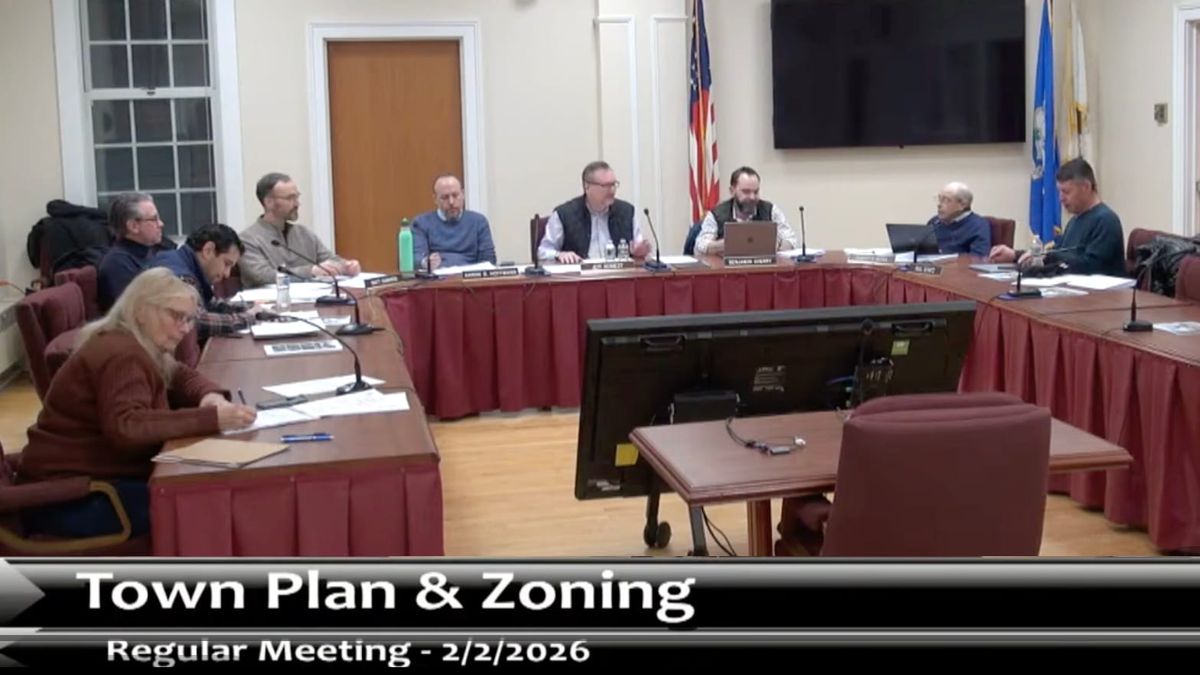
The Woodbridge Town Plan and Zoning (TPZ) Commission met Monday night to consider a wide-range of agenda items that included discussion of potential commercial-to-residential conversions, evolving state housing policy, and how the Commission wants to structure its work in the months ahead, including plans to make updates to its recently approved 2026-2036 Plan of Conservation and Development (POCD).
Informal request prompts discussion of commercial land use
Early in the meeting, commissioners heard an informal request for feedback from Buddy DeGennaro, who is involved in consideration of a future application regarding conversion of an existing commercial building at 27 Lucy Street to residential use — either condominiums or apartments. No application is before the Commission at this stage.
The discussion focused largely on what regulatory pathways might exist if a property owner seeks to reuse an existing commercial structure for housing, including whether changes to the zoning use table would be required and how such conversions might be framed to limit broader precedent.
Several commissioners pointed to the potential benefits of reusing existing buildings rather than constructing new ones. At the same time, the conversation did not directly address the cumulative effect of converting commercial properties to residential use on the town’s business districts. While individual conversion proposals are often evaluated site by site, the aggregate impact of such changes can shape the town’s long-term fiscal balance. Commercial properties typically contribute to the tax base without generating school enrollment or residential service demands.
As Woodbridge continues to explore housing options — whether through reuse of existing buildings or zoning changes — questions about the long-term balance between residential and commercial tax base were not discussed during Monday’s meeting, but remain an important context for understanding how individual land-use decisions add up over time.
Commission members emphasized that their discussion did not constitute a review or decision, and that any future proposal would need to proceed through the formal application and review process.
Implications of new state housing law on zoning updates
During the Commission’s work session, Town Planner Michael D’Amato outlined how Public Act 25-1, “An Act Concerning Housing Growth,” adopted during the November 2025 special session of the Connecticut General Assembly, will affect Woodbridge beginning July 1.
He said that, among other provisions, the new law allows up to nine residential units as of right in commercial and mixed-use zones statewide, subject to a streamlined review process. D’Amato explained that if Woodbridge does not adopt local standards addressing such conversions, applications would still move forward, but would be evaluated using existing commercial zoning standards, such as setbacks, parking, and site layout, because no residential-specific standards would be in place. He noted that guidance from the Office of Policy and Management and regional Councils of Governments encourages towns to adopt site-plan standards tailored to these conversions.
Several commissioners questioned whether nine-unit projects would be economically viable in a town like Woodbridge, given high land and construction costs. D’Amato indicated that similar concerns had accompanied the state’s accessory dwelling unit mandate, which ultimately resulted in fewer units being built than initially anticipated.
The discussion focused less on projected volume than on quality and compatibility. Commissioners raised concerns that, without local guidance, projects could technically comply with state law while producing outcomes inconsistent with Woodbridge’s planning goals.
Accessory dwelling units emerge as a focal point — and a data gap
As the discussion continued, commissioners spent considerable time on accessory dwelling units (ADUs), signaling shared interest in understanding how the existing ADU framework is functioning in Woodbridge before considering any changes.
D’Amato reviewed how ADUs have evolved under state law, noting that while ADUs are generally permitted as of right, their actual uptake has been modest in towns like Woodbridge. Commission Chair Jeff Kennedy noted that the Commission had previously updated the zoning regulations to align with the state’s ADU requirements several years ago.
As a result of those regulatory changes, D’Amato observed that some pre-existing units in Woodbridge may have been effectively grandfathered, and that the town does not currently have a clear picture of how many ADUs exist, where they are located, or under what conditions they were established.
Several commissioners suggested that a logical first step would be to establish a clearer baseline by identifying the number and types of ADUs already in use before considering whether any regulatory adjustments are needed. Commissioners generally viewed ADUs as incremental and homeowner-driven, and noted that this approach appears to be more readily accepted by the public than larger-scale housing changes. Several asked for additional information to help them better understand how this option might be explored further.
D’Amato also highlighted that the required affordability restriction period for ADUs has been reduced to ten years, a change he said may be more palatable to property owners considering whether to designate a unit as affordable. As this is a relatively recent change, it was noted that many property owners in Woodbridge may not yet be aware that this option exists.
The discussion also touched on how ADUs factor into the town’s affordable housing obligations. Commissioners noted that building an ADU and having it count toward affordable housing targets are separate issues. Only units that meet specific affordability criteria and deed restrictions are eligible to count toward statutory thresholds.
Housing Trust Fund raised as a tool, with cautions
The conversation also turned to the role a local Housing Trust Fund could play in supporting housing policy goals, particularly if Woodbridge explores new inclusionary zoning requirements or incentives tied to affordability.
D’Amato explained that one mechanism for funding such a trust would be through inclusionary zoning provisions, under which developers of certain projects could be required either to provide affordable units or make a financial contribution in lieu of doing so.
Commissioners discussed potential uses for a Housing Trust Fund, including offsetting municipal costs associated with housing incentives — for example, helping defray the budget impact of a tax incentive program for homeowners who agree to designate an ADU as affordable for a defined period.
At the same time, the discussion raised concerns about administrative capacity. It was noted that Woodbridge does not currently have staff dedicated to affordable housing administration, and that existing staff is already stretched thin. It was also noted that a town-wide hiring freeze has recently been announced, adding to concerns about the town’s ability to absorb new administrative responsibilities. In that context, commissioners questioned whether a small town like Woodbridge has the internal capacity to manage a Housing Trust Fund or oversee ongoing affordability compliance without additional resources.
D’Amato also noted that the administrative burden on property owners who designate units as affordable can be significant, involving deed restrictions, income certification, reporting requirements, and ongoing compliance obligations. He indicated that these requirements apply to ADUs as well as larger multi-unit developments, and may act as a deterrent to participation in affordable housing programs — a concern he said is also being surfaced in other communities statewide.
Commissioners discussed that if developers are given the option to pay into a fund rather than construct affordable units, a likely outcome might be additional market-rate housing rather than deed-restricted affordable housing. Because the state’s ten percent affordability goal is calculated as a share of the total housing stock, market-rate units increase the denominator, while paid-in-lieu contributions do not increase the number of deed-restricted affordable units — the numerator. It was observed that over time, this dynamic can make it harder for Woodbridge to approach the goal, even as new housing is built.
Taken together, the discussion underscored the complexity of aligning state housing mandates with Woodbridge’s existing zoning framework, environmental priorities, and administrative capacity. Commissioners acknowledged that while some state requirements will take effect on a defined timeline, others raise broader policy questions that warrant more deliberate consideration as the statewide discussion continues and the legislature considers potential adjustments this session — setting the stage for a more structured approach to updating local planning documents.
Chair outlines proposed working group to develop POCD updates
Near the close of the meeting, Kennedy outlined a next step he is proposing for the Commission: forming a small working group or subcommittee to develop recommended updates to the recently adopted POCD for consideration by the full Commission.
Kennedy noted that the Commission has previously identified weaknesses in the current POCD, including the way it incorporates the town’s affordable housing plan — which, according to the town planner, no longer reflects current state law now that the requirement for Regional Growth Plans has been introduced. It was suggested that a focused working group could help untangle those issues while also examining how housing policy fits within the POCD’s broader conservation, environmental, and land-use framework, proposing targeted revisions to the entire document for the Commission to consider.
Kennedy said he has been working with town counsel on how such a group might be structured and suggested a membership of no more than ten, noting a need for the group to work efficiently while still allowing for a range of perspectives. He proposed that the working group could include members of other relevant boards and commissions, such as the Economic Development Commission and the Conservation Commission, as well as residents who are not currently serving on town boards, in order to broaden input and expertise.
To reduce logistical barriers, Kennedy noted that meetings could be held virtually, if desired, to expedite its work. He also acknowledged that establishing a formal subcommittee of TPZ would trigger procedural requirements, including posting agendas and producing meeting minutes, with corresponding implications for staff workload.
The goal of establishing the subcommittee, Kennedy said, would be to assign detailed, focused work on POCD updates to a smaller group, while allowing the full Commission to continue grappling with the near-term implications of the new state housing law it will need to be prepared to address before July 1. The subcommittee would be tasked with developing concrete, well-vetted recommendations to bring back to the full Commission, supporting TPZ as it pursues a more deliberate and organized approach, rather than piecemeal or deadline-driven decision-making.
No formal action was taken Monday night, but the discussion set the stage for continued work on housing policy, zoning tools, and how Woodbridge positions itself as state requirements continue to evolve.
TPZ meetings are open to the public and recordings can be viewed on the town’s YouTube channel, WGATV79. Click below to watch the full February 2, 2026 meeting recording.