This Week’s Letters to the Editor
October 20, 2025

Editor’s Note: The Letters to the Editor section in the Woodbridge Town Chronicle is a place where community voices can be shared and heard. In the print newspapers of years past, letters to the editor were often the liveliest section, where readers spoke directly to one another, the broader community, and its leaders. To submit a letter for consideration please refer to the submission guidelines.

Imitation may flatter — but facts still matter
To the editor,
It’s often said that “Imitation is the sincerest form of flattery.”
In their recent mailing, Chairman Ellen Scalettar and the WDTC have certainly shown their admiration for the Common Ground for Woodbridge’s excellent mailers. Looking at the WDTC flyer, I thought, “You nearly nailed it.” The design is almost identical, but the content is missing two essentials: truth and transparency.
To begin with it is untrue and ridiculous to say Common Ground for Woodbridge candidates “have active engaged in delaying growth in Woodbridge” or that their campaign involves “out of town CT Republican political operatives.”
Common Ground for Woodbridge is true to its name. It is a powerful coalition of town residents of all affiliations eager to rise above typical party politics and work together to solve the huge problems we are facing. They are fed up with the Democratic administration’s controlling tactics and bungling of issues from zoning and taxes to economic development and the future of the former CCW and Beecher Road School.
The Common Ground for Woodbridge candidates for BOS have expertise and experience in finance (Javier), law (Rob), land use/conservation (Andrea), and even in running the town (Amey). They are ready to roll up their sleeves and work for all of us.
As a lifelong resident who loves Woodbridge, I urge you to vote for positive change with Common Ground for Woodbridge.
Vote Row B on November 4.
— Martha German
After years of losses, it’s time to move forward on CCW
To the editor,
I can understand disagreement on political grounds, but I don’t understand why there is dispute about plans for the Country Club of Woodbridge (CCW) property. We have an opportunity to remedy a series of financial missteps:
First, the town paid $7 million to obtain the property, of which about $1million was paid mainly to compensate former Club members who had claims against the Club (see New Haven Register article published 3/30/09). Why should taxpayers subsidize club members?
Second, the town decided to operate the Country Club, when country clubs around us were failing. Could a town swing the CCW to a profit when private ownership had tried for years and failed? More losses for taxpayers to bear.
Third, principal repayments and interest on the $7 million are hitting the budget every year while we dither.
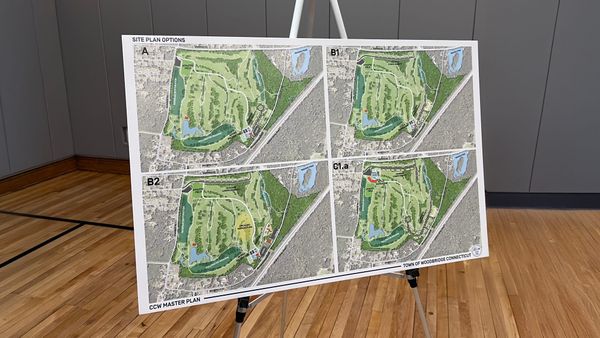
Let’s seize the opportunity. The current town proposal makes an effort to raise some tax revenue from the property. Maintaining much of the property as green space while replacing the previously built-up areas with smaller residences makes ecological and aesthetic sense. Restricting the homes to seniors makes financial sense.
Frankly, the Missus and I have a personal incentive: we would like to move into one of those homes! We came to Woodbridge over two decades ago, as an older couple, and have loved living here. We made many friends and enjoy the hiking trails and overall beauty. Please help us, and others like us, stay!
— Jake Thomas, an apolitical resident of Woodbridge
How leadership decisions are shaping Woodbridge’s future costs
To the editor,
I feel compelled to respond to the latest Woodbridge Democratic Town Committee (WDTC) election flyer disputing claims made by Common Ground. The flyer insists that First Selectman Mica Cardozo had no role in the disaster at 804 Fountain Street — a 96-unit apartment complex larger than a football field.
While it’s true that the First Selectman has no vote on the Town Plan and Zoning Commission (TPZ), he serves as an ex officio member and attended the December 2 meeting when the zoning change was approved. As the town’s chief elected official, he should have been fully engaged with the TPZ about the project’s impact. His failure to do so was a failure of leadership.
Instead, the flyer shifts blame to the TPZ — an appointed board made up largely of WDTC members, including its former chair. The idea that this was solely the TPZ’s doing is absurd. Notably, that chair — himself a member of the WDTC — abruptly resigned without explanation on September 22, leaving the board in turmoil. Is he being made the scapegoat for this mess?
The flyer also omits mention of this year’s 5% tax increase, the largest in years. Combined with revaluation, some taxpayers saw their bills soar by as much as 70%. Yet town leadership did nothing — such as phasing increases — to ease the burden. As one speaker noted in Public Comments at a recent Selectmen’s meeting, this too reflects a failure of leadership.
Finally, they tout a “brilliant” Country Club plan that most residents oppose, citing an unproven $2 million revenue stream, and praise a costly Beecher Road School project — just ten years after voters approved a $13 million bond to keep Beecher “set until 2035.”
If the First Selectman’s long-term capital plan proceeds, the tax hikes we endured this year will seem mild by comparison.
— Matthew T. Giglietti
The writer was a member of the Woodbridge Board of Finance from July 1986 to December 2023 where he served as Chairman for 35 years (1988–2023).
Leaders had tools to ease the tax burden — and chose not to use them
To the editor,
One of us had a significant tax increase this year. The other a tax decrease.
Connecticut law requires towns to update property assessments to reflect current market values. That’s fair in principle — but when home values rise unevenly, some residents face sharp tax hikes while others benefit from cuts. For many long-time homeowners and seniors, those sudden increases are life-changing.
The revaluations occurred across Connecticut last fall, with similar outcomes. But the pain some Woodbridge residents are experiencing is not shared everywhere in Connecticut.
Simply put, leaders of cities and towns in Connecticut have options to mitigate the pain. State law (CGS §12-62c) gives towns a proven way to ease that burden: a phase-in. This option lets a town spread large assessment increases over several years. For example, if a home’s assessed value rose from $100,000 to $160,000, the town could phase in about $12,000 of taxable valuation per year over five years instead of applying the entire $60,000 increase immediately. This softens the shock, keeps revenue stable, and gives residents time to adjust.
Leaders have the ability and responsibility to respond – to make the impact of rising home valuations easier on their constituents and enable them to remain in their homes. Many of our neighboring towns have successfully elected this option.
Woodbridge’s leadership refused.
There were many excuses provided: too disruptive (not true), the residents would have to pay it back anyway (not true), the town would need to manage two sets of books (not true). The choice not to phase in shifted the full weight of revaluation onto our neighbors who can least afford it.
We have a choice.
It’s time to choose leaders who are willing to fight the affordability crisis right here at home.
— Scott Prud’homme and Javier Aviles
The writers are both members of the Board of Finance; Javier Aviles is also a candidate for the Board of Selectmen on the Republican Party–endorsed slate (Row B on the ballot).
Editor’s Note: Letters reflect the perspectives of their authors. They are published to foster dialogue about issues of local concern, including questions of governance, transparency, and accountability, as well as topics such as highlighting upcoming or past events from community groups. To submit a letter for consideration please refer to the submission guidelines.