Selectmen tackle biennial board and commission appointments at first meeting of new term
From anticipation to action: appointments reduce vacancies with expanded reliance on unaffiliated voters to meet minority-party rules

From anticipation to action: appointments reduce vacancies with expanded reliance on unaffiliated voters to meet minority-party rules
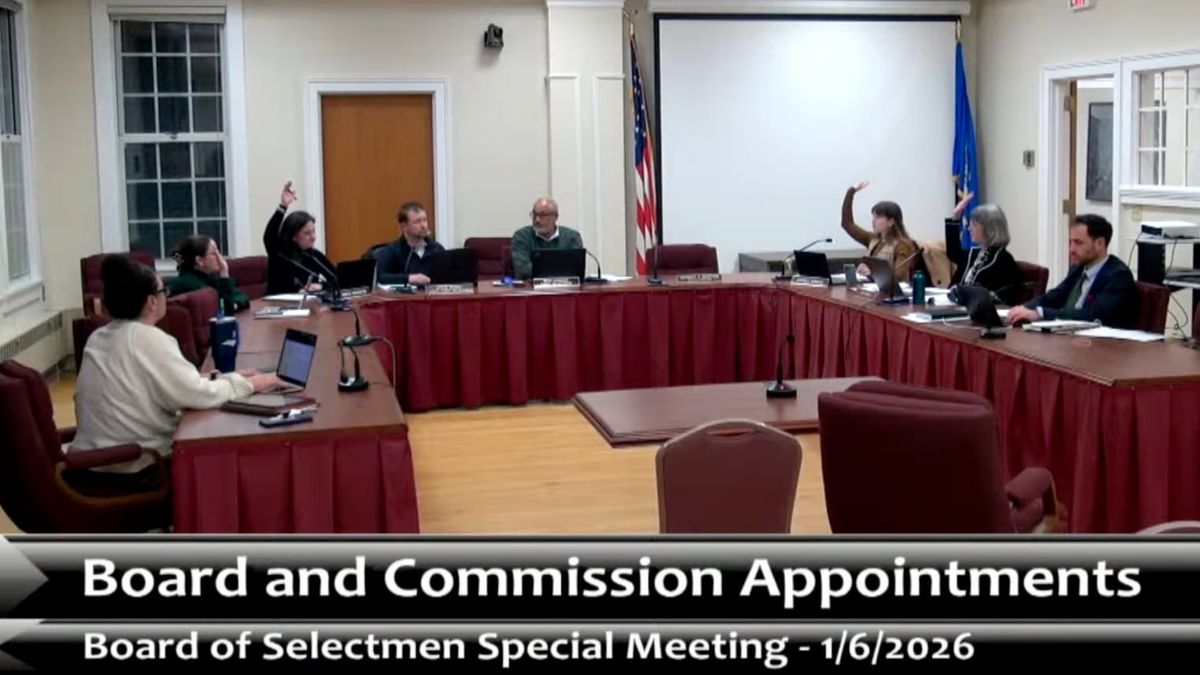
At a special meeting on January 6, the newly elected Board of Selectmen took action on Woodbridge’s biennial round of appointments to the Town’s standing boards and commissions, filling seats whose four-year terms began on January 1, 2026. This chapter of the appointment cycle set the membership of most appointed bodies for the new governing term (one exception being the newly created Charter Revision commission which must be appointed by early-February, 30 days after the vote to establish taken at the January 6 meeting — see meeting coverage for details).
Under Chapter 75 of the Town Code, the Board of Selectmen is responsible for appointing residents to Woodbridge’s standing boards and commissions every two years, with four-year terms staggered so that roughly half expire in each cycle. Although the Charter allows for these appointments to be made at a special meeting of the Selectmen-elect prior to the start of the new terms, this year that meeting did not take place.
These appointed boards and commissions carry much of the Town’s ongoing work, including land-use review, fiscal oversight, stewardship of public assets, public safety oversight, and advisory responsibilities across Town departments. Collectively, these bodies function as the Town’s primary venues for resident participation in municipal governance, helping to translate policy direction from elected officials into detailed review, oversight, and recommendations across a wide range of subject areas.
2026 membership snapshot
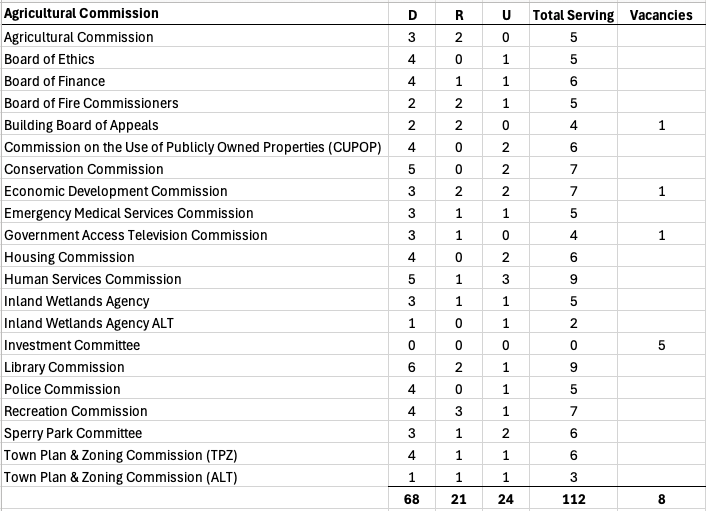
Following the January 6 appointments, Woodbridge’s standing boards and commissions include 112 serving members, with 8 vacancies remaining. This represents an increase in overall participation compared to the close of the prior term (see previous reporting), though several bodies continue to operate with unfilled seats.
Based on an analysis of the votes at the January 6 meeting, party enrollment across all appointed boards and commissions is as follows:
• 68 Democrats
• 21 Republicans
• 24 Unaffiliated voters
While Democrats continue to hold a clear majority of appointed seats town-wide, the most notable feature of the impact of new appointments on overall composition of these boards and commissions is the substantial role played by unaffiliated members across many boards.
Minority-party representation and unaffiliated members
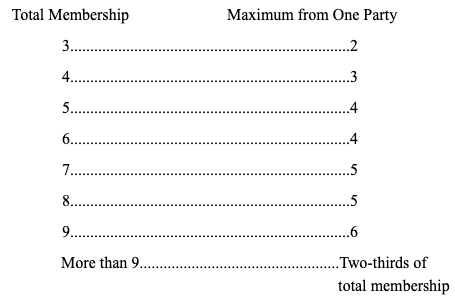
Connecticut General Statutes § 9-167a limits how many members of any one political party may serve on a public body, with the maximum determined by total board size. For example, no more than four members from a single party may serve on a six-member board, and no more than five on a seven- or eight-member board.
In Woodbridge, compliance with these minority-party representation rules in 2026 is achieved primarily through the appointment of unaffiliated voters, rather than through proportional appointments from the two major parties alone. Across multiple boards — including advisory, administrative, and land-use bodies — unaffiliated members are counted toward the minority-party cap, allowing boards to meet statutory requirements while maintaining a Democratic majority.
As a result, unaffiliated residents will play a structurally significant role in the Town’s appointed governance system, both as individual contributors and as a key element in ensuring boards are lawfully constituted.
New Housing Commission expands appointed governance in a key policy area
Another notable development in the 2026 appointment cycle is the formation of the Housing Commission, a newly established standing body that did not exist in prior terms. It represents the single largest source of newly created appointed seats in this biennial cycle and, as a result, accounts for a significant share of the net increase in appointed seats reflected in the 2026 composition data.
The Housing Commission is expected to begin its work in January with six appointed members, reflecting a deliberate expansion of appointed governance in a policy area of growing importance. As constituted for 2026, the Housing Commission includes four Democrats and two unaffiliated members, with no Republican appointees. This composition brings the commission into compliance with Connecticut’s minority-party representation requirements exclusively through the inclusion of unaffiliated members, consistent with patterns seen across other appointed bodies. The creation and initial appointment of the Housing Commission comes amid increased attention to housing availability, affordability, and planning at both the local and state levels. Its work is expected to intersect closely with ongoing implementation and future updates of Woodbridge’s Plan of Conservation and Development, as well as with new state housing legislation enacted in December.
Vacancies and boards to watch
While most boards and commissions are fully appointed for the 2026 term, eight vacancies remain, including:
• Five seats on the Investment Committee, as the Selectmen took no action on these appointments at their January 6 meeting.
• One vacancy each on the Building Board of Appeals, Economic Development Commission, and Government Access Television Commission
Appointments to these seats are expected to occur later in the term as nominees are identified.
In addition, membership on ad hoc committees, which are authorized by vote of the Board of Selectmen and appointed by the First Selectman, is expected to be addressed separately from the biennial standing-board process.
Looking ahead
With the bulk of appointments now complete, attention will shift from board composition to board performance. The January 2026 appointments establish the volunteer leadership that will review development proposals, oversee municipal assets, advise on budgets, and shape policy discussions over the next two years.
As these boards begin their work, their decisions — and the way they function with newly appointed and returning members — will play a central role in how Woodbridge governs itself and how the Selectmen are advised during the 2026-2027 term.