Selectmen Advance Housing Commission Ordinance, Debate Charter Revision
October meeting also includes limited CCW discussion and a TPZ appointment
The Woodbridge Board of Selectmen met in regular session on Wednesday, October 8, 2025. The evening’s agenda included updates on education and historic preservation, adoption of the Housing Commission Ordinance, discussion of charter revision, and an appointment to fill a vacancy on the Town Plan and Zoning (TPZ) Commission.
Motion to Add CCW Discussion Fails
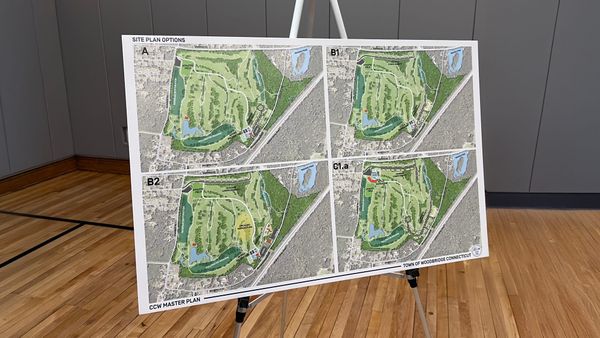
Early in the meeting, a motion was made to amend the agenda to include discussion of the Country Club of Woodbridge (CCW) Master Plan and its next steps. Supporters of the motion said recent campaign materials had caused confusion by suggesting that a “new CCW plan” had received unanimous support from the Board when, in fact, no such vote had been taken to accept the final plan document. They argued that the public deserved clarification before Election Day.
Others preferred to hold a separate, well-noticed meeting to discuss next steps as the agenda for the October meeting was already full. It was clarified that the Board’s only unanimous action to date was its vote authorizing consultants to investigate options for the property — not to adopt these options as part of the final plan — but that further discussion of ‘next steps’ should take place at a future meeting.
After discussion, the motion to amend the agenda resulted in a 3–3 tie, with the First Selectman voting to break the tie in opposition, leaving the published agenda unchanged. The First Selectman added that a special meeting on the CCW plan may be scheduled before November to allow fuller public participation.
Historical Society Updates and HRF Grant
Representatives from the Amity and Woodbridge Historical Society presented updates on the Thomas Darling House caretaker’s residence and requested Board approval for a new tenant lease. The Board reviewed the proposal and voted to support the Historic Restoration Fund (HRF) grant submission to the state, authorizing the town to act as fiscal agent for the project. The grant would assist with preservation work on the Darling House property, a key site in Woodbridge’s historic landscape. It was noted that the required matching funds were already included in the approved Town budget.
Education and Finance Reports
Beecher Superintendent Christopher Montini provided an update on district operations and budget priorities for the Woodbridge Board of Education, noting stable enrollment and staffing heading into 2026. This October 1 saw 862 students enrolled, compared to last October 1 enrollment of 864.
Administrative Officer and Finance Director Anthony Genovese presented the monthly financial report, summarizing expenditures and revenues to date, and reviewed several funding requests, all of which were approved.
The Selectmen also approved all annual farm leases for the 2026 growing season, as presented. After rearranging the order of the agenda to accommodate the scheduled timing of public comment to begin at 6PM, the Selectmen approved the Consent Agenda.
Legal Aspects of CCW Master Plan Approval Path
During discussion of the near-final draft of the CCW Plan at the September Board of Selectmen meeting, it was noted that special town meeting approval would be required for any sale, lease, or restriction involving town-owned property at the CCW site and that a referendum vote would not be an option. At the October 8 meeting, the Town Attorney expanded on that point, explaining that questions had arisen during recent discussions with the CCW master plan team about what level of public approval would be required for future actions affecting the property.
It was reported that the Town Attorney is conducting a comprehensive legal review to determine whether such questions — whether initiated by the Board or by public petition — may also be placed on the ballot for a townwide referendum, as occurred in 2011. The review includes the 2009 town meeting and 2011 referendum history, relevant charter provisions, and Connecticut Supreme Court case law distinguishing when state statute preempts local authority versus when matters of local concern, such as fiscal or property questions, are governed by the charter as the town’s supreme local law.
The analysis remains ongoing, and a definitive legal opinion is not yet available. It was estimated that several weeks may be required to complete the review.
There was also discussion about the language in the CCW master plan appendix and FAQ referencing a potential referendum. It was suggested that the plan should note that legal review is underway and that any reference implying a referendum “granted by state statute” be clarified or revised pending counsel’s written opinion.
It was also noted that if the question remains unresolved, a future charter revision could be used to specify the approval process for major property transactions. The Selectmen recognized that regardless of the outcome of the ongoing legal review, public participation will be included through a special town meeting — and possibly a referendum, depending on the findings. A written opinion was requested for the next Board meeting, and related plan references, including the FAQ on page 50, were flagged for follow-up when the Selectmen next discuss the plan before the Board moved to public comment. Several members of the public offered comments — see meeting video for details.
Housing Commission Ordinance Adopted
In a significant action item, the Board voted unanimously to adopt the Housing Commission Ordinance, following a public hearing held September 10 and subsequent committee review. The ordinance will take effect on November 8, 2025, thirty days after adoption, and will be posted in the town’s online Code of Ordinances once codified.
The measure formally transitions the two previous temporary ad hoc committees that addressed affordable housing issues into a standing Housing Commission tasked with promoting housing diversity consistent with the town’s land-use plan and state housing statutes.
In contrast to the previous ad hoc committees whose members were appointed by the First Selectman, the new commission will consist of six members appointed by vote of the full Board of Selectmen. In keeping with state statute requirements, no more than four members will be from the majority party, and at least two will be from a non-majority party or unaffiliated. The initial terms of each appointed commissioner will be staggered: three will begin with four-year terms and three with two-year terms, ensuring that only half the commission’s terms expire in each appointment cycle to promote continuity.
During discussion, members noted that because the new commission will have an even number of seats, future tie votes could require the chairperson to break a tie. Some suggested that eliminating the charter provision that allows for chairpersons of commissions — and the First Selectman — to break a tie could be considered in a future charter revision to enhance procedural fairness.
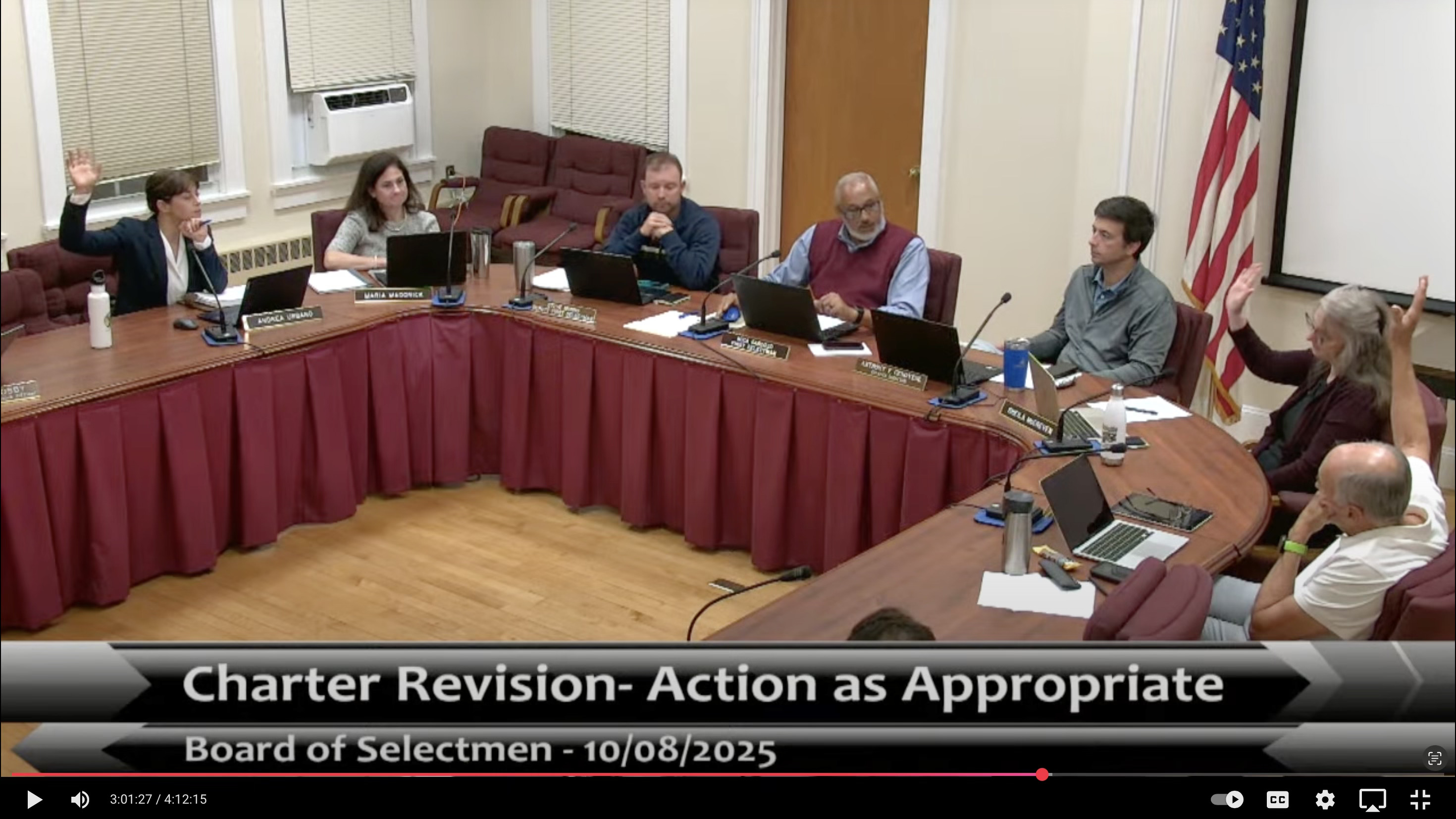
Charter Revision Discussion and Vote
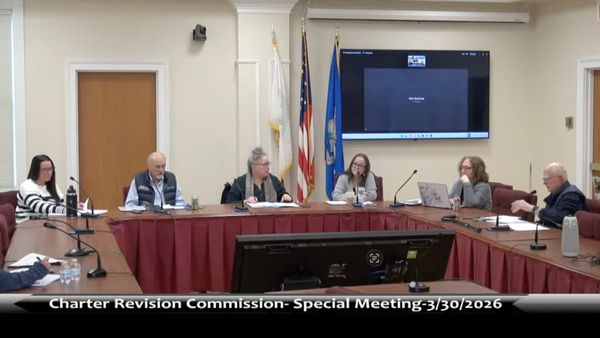
The Board then turned to an agenda item to initiate a Charter Revision Commission (CRC), a process that allows the town to consider changes to its governing “constitution.” A motion was introduced to establish a seven-member commission in accordance with Connecticut General Statutes §§ 7-187 and 7-188.
During discussion of the motion, members reviewed statutory requirements for forming a CRC and setting its reporting deadline. State law allows the Board to give the commission up to 16 months from the date of appointment to submit its draft report, though a shorter period may be set at the Board’s discretion.
The Selectmen discussed whether the creation of a CRC should wait until the next Board is seated in January 2026 so that the same BOS that initiates is also in place at the completion of the charter revision process.
It was noted that the CRC’s work will be complex and may require legal guidance as well as sufficient time for public education so residents can fully understand any proposed changes before voting. It was also noted that the six-month deadline proposed for action at this meeting might be too short, given the scope of the work and the need for clear ballot language.
Potential Topics for Charter Revision
During the discussion, several potential topics were identified for possible inclusion in the CRC’s charge, including:
- Clarifying the process for public approval of major financial and property decisions — such as sales, long-term leases, and restrictions involving town-owned land — and defining or clarifying when those matters require town meeting or referendum approval.
- Considering updates to provisions related to budget approval, including whether all annual budgets should automatically go to referendum or only when the proposed increase exceeds a defined threshold (for example, 3%, 4%, or 5%).
- Reviewing the town’s appointment procedures for boards and commissions, with interest in establishing a more transparent and formal vetting process for appointees, and possibly altering the charter to disallow a tie-breaking vote by the chair or First Selectman.
- Examining whether certain boards should become elected rather than appointed, particularly the Plan and Zoning Commission and Board of Finance, reflecting ongoing community debate about representation and accountability.
It was noted that the Board is not required to include details of topics for the CRC to consider. Instead, if it chooses to, the BOS may refine or expand this list at a future meeting before including topic details in the formal charge to the CRC.
There was also discussion of the appointment process for CRC members. A careful, transparent, and inclusive selection process was described as essential to public confidence in the commission’s work. Concerns about appointment procedures were linked to public interest in electing rather than appointing certain boards — such as the Plan and Zoning Commission and Board of Finance. It was suggested that the Board take additional time to refine the town’s appointment process before naming CRC members, allowing the new commission to serve as an example of that improved approach.
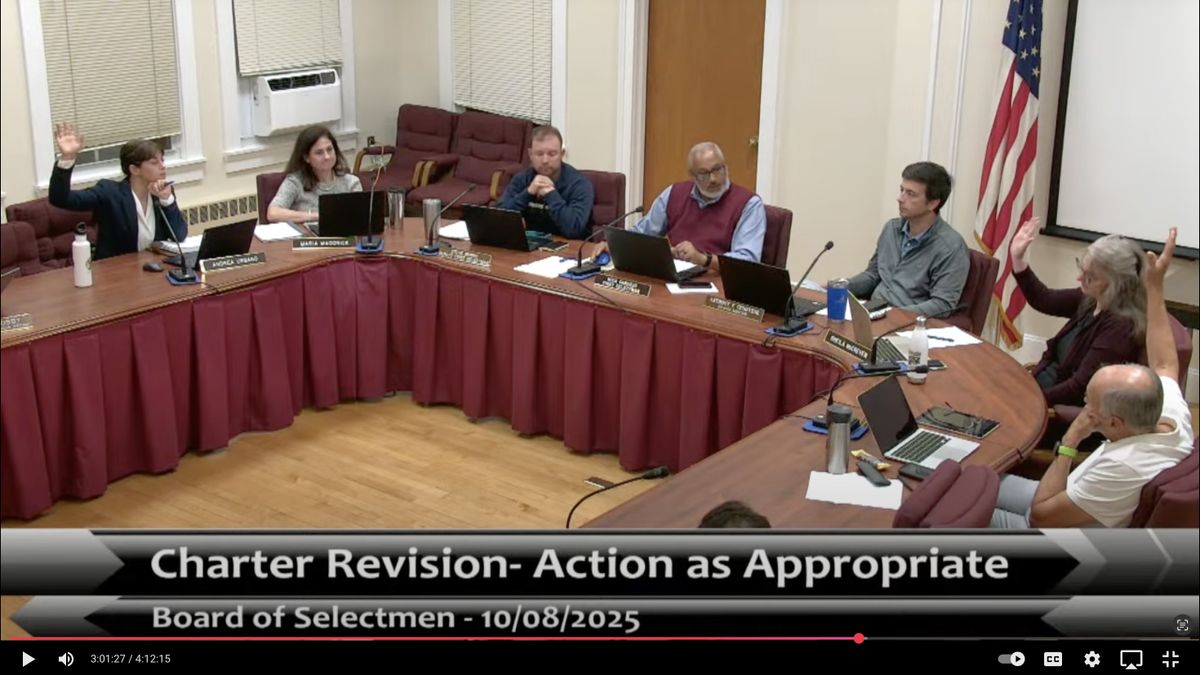
The vote to initiate Charter Revision resulted in a 3–3 tie, and under Connecticut General Statutes § 7-188, the First Selectman may not cast a tie-breaking vote on such a motion. As a result, the motion failed. Discussion is expected to continue at the Board’s next meeting, when the Selectmen may revisit potential topics to include in the CRC’s charge, consider adjustments to extend the overall timeline, and explore improvements to the appointment process for commission members.
TPZ Appointment Follows Debate and Tie Vote
The meeting concluded with action to fill a vacancy on the Town Plan and Zoning Commission (TPZ) following the September resignation of Robert Klee, who was serving as TPZ Chair.
The proposed appointment prompted discussion about the selection process and the balance of representation on the commission — a theme that echoed concerns raised earlier during the Charter Revision debate. Some members noted that the appointment would result in four members of the Woodbridge Democratic Town Committee serving simultaneously on TPZ, while others cited the nominee’s qualifications and past public service experience as reasons to move forward.
After considerable debate, the vote was 3–3, and the First Selectman broke the tie in favor, appointing James Horwitz to fill the TPZ vacancy for a term ending December 31, 2027.
The meeting was then adjourned, shortly after 9:00 PM. The Selectmen’s next regular meeting is scheduled for Wednesday, November 12, 2025, at 5:00 p.m. in the Town Hall Central Meeting Room. If an additional October meeting is added, the meeting notice will appear in advance, as a listing on the town website’s Agenda Center page. BOS meetings are open to the public and streamed live on the Town’s YouTube channel, WAGTV79.
Editor’s note: This recap is written by Sheila McCreven in her role as editor of the Chronicle. Sheila is also an elected member of the Board of Selectmen (her term ends December 31, 2025). See the Editorial Note on Government Coverage on our About page to learn more.