Selectmen advance FY 2027 budget recommendation to BOF
Infrastructure Pressures and Operating Restraint Shape Selectmen’s Budget

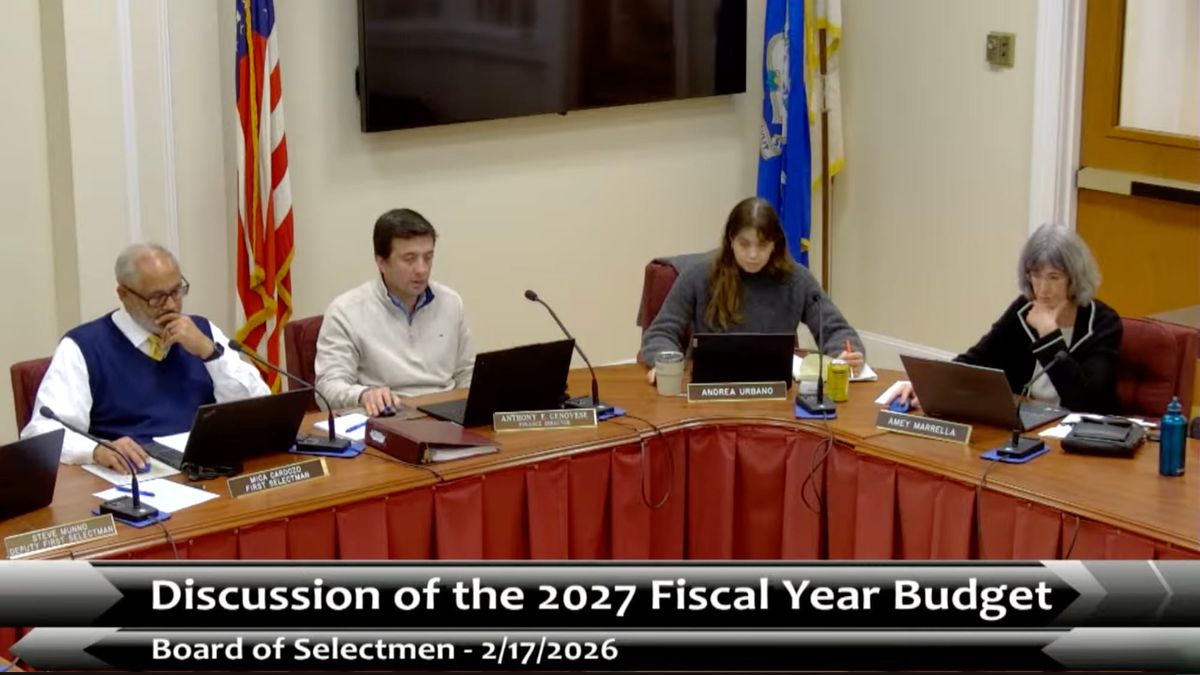
Following several weeks of budget presentations in January, the Woodbridge Board of Selectmen (BOS) concluded its FY 2027 budget deliberations at its February 17 meeting. At the end of the four-hour meeting, the Selectmen voted to advance their recommendation to the Board of Finance (BOF).
The meeting reflected two consistent themes: mounting infrastructure needs across multiple town facilities and an effort to moderate operating growth through broad-based restraint — including increased reliance on the contingency line and reconsideration of fund balance assumptions.
A look at revenue projections
Before turning to expenditures, the Board reviewed revenue projections for FY 2027. Discussion included an anticipated decrease in state motor vehicle tax reimbursement tied to the Town’s recent mill rate adjustment following revaluation, as well as a new proposal to assume $500,000 in revenue from the potential sale of publicly owned property. While neither item prompted extended discussion at that point in the meeting, both reflect a revenue posture that differs from recent years and form part of the broader fiscal context in which the Selectmen’s budget decisions were made.
Capital budget: Aging systems and long-term planning
Attention then shifted to the town’s five-year capital plan. Discussion centered on emerging initiatives such as a costly facility upgrade project at Beecher Road School, as well as on lifecycle realities. Among the projects discussed:
• Road repaving, including the possibility of shifting from traditional pay-as-you-go funding toward partial bonding
• HVAC system failures at Town Hall and the Center Building
• Roof replacement needs at several town buildings
• Police Department air conditioning reliability during summer months (the department occupies one wing of the Center Building)
• Firehouse mechanical systems approaching 20-year lifecycle benchmarks.
It was noted that the Firehouse, constructed in 2008, is nearing the point at which major building systems begin to require replacement planning. Selectmen acknowledged that while the building itself is relatively new, major systems are nearing replacement planning stages.
Similarly, HVAC challenges at Town Hall and the Center Building were framed as operational risks rather than optional upgrades, particularly given summer cooling needs for public safety operations.
Road paving generated discussion about financing approach. Woodbridge has historically funded repaving on a pay-as-you-go basis. The possibility of bonding some portion of future paving reflects a willingness to reconsider long-standing practice in light of competing capital pressures.
The capital plan was approved 4–2. Selectmen Amey Marrella and Andrea Urbano voted in opposition, citing the inclusion of funding tied to a potential Beecher Road School renovation or reconstruction project without first seeing modeled projections of its long-term debt impact alongside other necessary bonded projects. They described their opposition as specific to the absence of financial modeling rather than to capital maintenance projects more broadly.
Operating budget: Applying broad-based restraint
After capital review, the Board turned to the operating budget and proceeded department by department. Rather than targeting a single area for deep reductions, discussion reflected a broad-based effort to moderate growth across accounts to keep the overall operating budget increase as low as possible. Among the mitigation efforts discussed:
• Consideration of closing the Town Library one evening per week as a cost-control measure
• Potential fee increases at the Transfer Station
• Adjustments within the Recreation Department budget to increase fees to more fully cover costs to deliver programs such as Summer Camp
• Review of larger department operating budget expenditures, such as those planned by the Fire, Police, and Public Works departments together with EMS, these departments comprise the Town’s Public Safety costs).
The Public Safety operations discussion focused on balancing service reliability with cost containment, reflecting both staffing and equipment realities. No single department was singled out as the source of structural imbalance. Instead, the approach taken reflected modest trimming across multiple areas in an effort to temper overall growth while preserving service levels.
Increased contingency and discussion of fund balance
Two related fiscal adjustments signaled a more precautionary stance. First, the Board approved an increase to the operating contingency account. Discussion reflected recognition that infrastructure volatility, utility costs, and other variables could produce in-year surprises.
Second, the Selectmen acknowledged less certainty that recent patterns of favorable year-end variances will necessarily continue. In recent years, the Town has budgeted an $800,000 transfer from fund balance — a figure that has often not been fully needed by year’s end. Discussion suggested greater caution about assuming similar outcomes going forward.
While none of these adjustments alone would be extraordinary, their combination represents a notable shift from recent practice. Woodbridge has traditionally relied on conservative fund balance assumptions, pay-as-you-go capital funding, and modest contingency levels. The FY 2027 proposal reflects a budget built with a greater margin for uncertainty in light of aging infrastructure and large upcoming capital decisions.
Budget recommendation transmitted to Board of Finance
Following discussion, the Selectmen voted 4–2 to forward the adjusted FY 2027 operating and capital budget to the Board of Finance. Marrella and Urbano again voted in opposition, consistent with their earlier capital plan vote. The Board of Selectmen’s recommendation represents an overall budget increase of 4.84% over the current fiscal year.
The Selectmen’s role in shaping the proposal is now complete. At its upcoming meetings, the BOF will conduct its own review and vote to finalize the Preliminary Budget proposal that will go to public hearing in April. After the hearing, the BOF may consider further adjustment before making a final recommendation that will go to the Annual Town Meeting in May for approval.
The Selectmen are scheduled to gather again for their regular meeting on March 11, 2026 starting at 5 p.m. at Town Hall. Meeting notices for all BOS meetings appear in advance on the town website’s Agenda Center page. BOS meetings are open to the public and streamed live on the Town’s YouTube channel, WGATV79. Click below to watch the full recording of the February 17, 2026 meeting.