New analysis details what was missed in the CCW master plan
Menunkatuck Audubon Society highlights ecological significance, calls for protecting entire parcel as open space
The following report was presented to the Woodbridge Conservation Commission at its April 3, 2026 meeting. It is published here in its entirety as a Community Voice submission.

The Case for Protecting the Former Woodbridge Country Club Property as Open Space
Prepared by Dennis Riordan, President, Menunkatuck Audubon Society — March, 2026
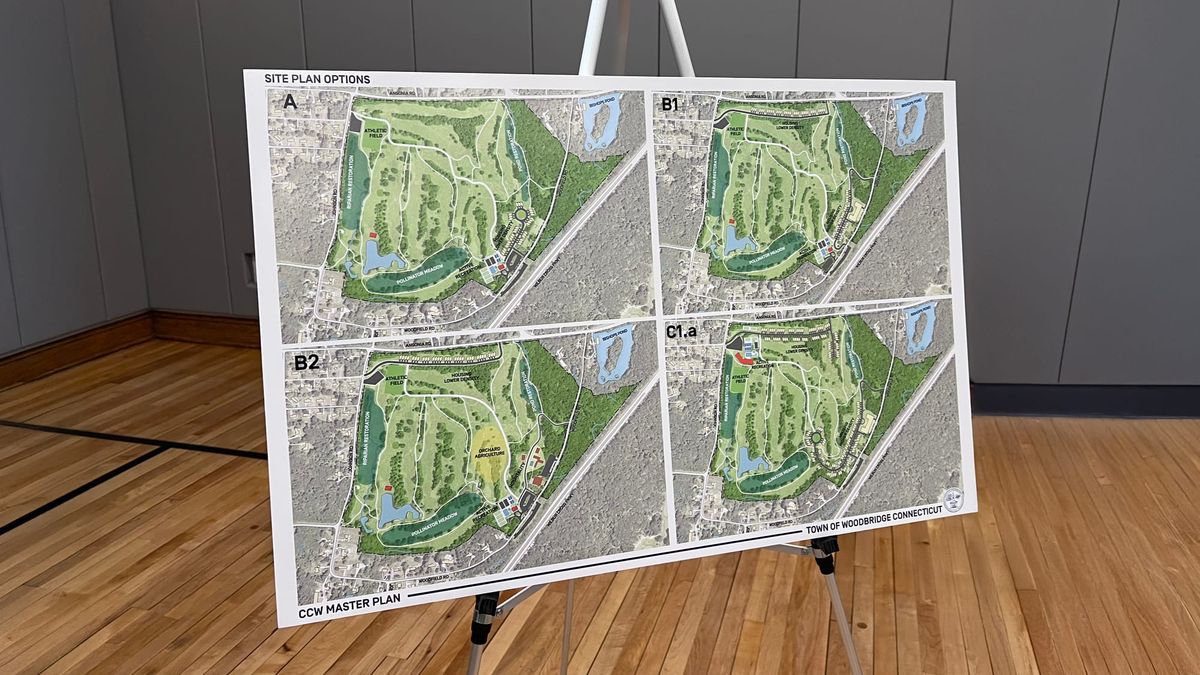
In 2025, the Town of Woodbridge released the Community Collaboration Woodbridge (CCW) Master Plan — a comprehensive planning document for the future use of the former Country Club property. The Master Plan involved extensive community engagement, market analysis, and cost-benefit modeling, and its preferred scenario retains approximately 116 acres as natural parkland while designating roughly 25 acres for residential, hospitality, and agricultural development.
While the Master Plan acknowledges environmental considerations in general terms and includes aspirations for ecological restoration, a careful review reveals that its process, assumptions, and financial framework systematically underweigh the property's environmental significance.
The plan was developed primarily through an economic and land-use planning lens, and critical environmental analyses that should inform any major decision about this property were absent from the process.
No independent wildlife impact assessment, wetland functional assessment, or ecological connectivity analysis was commissioned as part of the Master Plan process. The plan's development scenarios were designed without modeling how proposed construction zones would affect the documented habitat mosaic, the regional wildlife corridor, or the vernal pool complexes on the property. This is a significant methodological gap: development plans for a property of this ecological sensitivity should be informed by, not merely adjacent to, a rigorous ecological impact analysis.
The Master Plan's cost-benefit analysis is its most consequential analytical component: it is the tool used to argue that development generates net revenue and that no-development costs the town money. But the analysis is structured in a way that renders the property's environmental and ecological value invisible.
In 2022, Audubon Connecticut conducted a comprehensive habitat assessment of the former WCC property at the town's request. The assessment included systematic field surveys, breeding-bird point counts, habitat mapping, and landscape context analysis. Its findings were unambiguous: the property supports a diverse and ecologically significant plant and animal community that would be greatly reduced or lost through typical residential or commercial development.
The assessment identified the property as a Priority Bird Conservation Area, documenting over 70 bird species, including area-sensitive forest-interior breeding species that require large, unfragmented patches of mature woodland. Species recorded include:
- Wood Thrush (Hylocichla mustelina) — a species of conservation concern whose populations have sharply declined due to habitat fragmentation.
- Eastern Wood-Pewee and other forest-interior neotropical migrants.
- Red-shouldered Hawk — a Connecticut Species of Special Concern dependent on forested wetland habitats.
- Multiple grassland and shrubland bird species utilizing the transitional habitats created by former fairway edges.
- Waterfowl and wetland-associated species using the on-site ponds and stream margins.
The assessment noted that the property's mix of mature upland forest, forested wetlands, open meadow habitats, and water features creates a mosaic of habitat types rarely found together in a single contiguous parcel of this size within a suburban landscape. This diversity supports a much broader range of species than any individual habitat type alone.
The Audubon Connecticut assessment was not considered in the Master Plan.
Other ecological surveys documented the presence of several natural community types that are uncommon in Connecticut's developed landscape, including:
- Red maple-hardwood swamp, a high-quality forested wetland community supporting amphibians, reptiles, and invertebrates.
- Transitional shrub-scrub habitat along former fairway edges, providing critical nesting and foraging habitat for shrubland-obligate birds like Prairie Warbler and Yellow Warbler.
- Mature oak-hickory upland forest with significant canopy cover and structural complexity, indicating long-term forest continuity. Vernal pool complexes support spotted salamanders, wood frogs, and potentially other amphibian species that depend on seasonal ponding.
These communities took decades to develop after the golf course was established and would require a century or more to fully recover if disturbed. Their loss to development would be permanent on any human timescale.
One of the most compelling findings of the habitat assessment relates to the property's role in regional landscape connectivity. Woodbridge is part of a larger forest network that connects several significant conservation areas in the region, including Sleeping Giant State Park, West Rock Ridge State Park, the Naugatuck State Forest system, and the South Central Connecticut Regional Water Authority lands. The former WCC property serves as a crucial stepping stone and link within this network, enabling wildlife to travel between these larger areas without crossing busy roads or developed lands.
Fragmentation of this corridor — even by moderate-density residential development — would effectively disrupt wildlife movement for wide-ranging species such as white-tailed deer, fisher, red fox, eastern box turtle, and migratory songbirds. Maintaining this linkage as open space helps sustain biodiversity not only on the property itself but across a larger regional landscape.
These assessments were not considered in the Master Plan.
Multiple wetland systems have been documented on the property, including palustrine forested wetlands, emergent marshes, and open-water ponds. These systems offer a range of services beyond providing wildlife habitat.
- Flood attenuation — absorbing and gradually releasing rainfall, reducing downstream flood damage.
- Water quality improvement — removing nitrogen, phosphorus, sediment, and other contaminants through natural biological and physical processes. Carbon sequestration — forested and scrub-shrub wetlands store substantial quantities of soil carbon.
- Aquifer recharge — contributing to the replenishment of local drinking water supplies.
Connecticut's inland wetland regulations provide these areas with legal protection, but their hydrological functions rely on the integrity of the surrounding upland buffer. Development of adjacent uplands—even when wetlands themselves are nominally avoided — reduces wetland function and resilience over time.
The value of the wetlands was not considered in the Master Plan.
The habitats documented on this property — mature forests, forested wetlands, shrubland edges, vernal pools, stream corridors — took generations to develop. The wildlife communities they support, from forest-interior breeding birds to amphibians and wide-ranging mammals, rely on the scale and continuity of this landscape in ways that cannot be replicated once the land is developed.
The regional wildlife corridor that the property anchors connects Woodbridge to a much larger network of conservation lands and benefits biodiversity beyond the town's borders. Woodbridge has a once-in-a-generation opportunity to act.
However, at the request of the Woodbridge Conservation Commission, Menunkatuck will conduct two seven-week bird surveys in the spring and fall of 2026. To complement the earlier assessments, the surveys will use autonomous recordingunits (ARUs). These ARUs will be deployed at four locations on the property, spaced about 600 meters apart. They will record bird calls for four hours around dawn and dusk. The recordings will then be analyzed with AI software, and a report will be presented to the Conservation Commission.
Beyond its ecological and recreational value, the former Woodbridge Country Club property is of significan't historical importance, further reinforcing the case for its preservation. Originally known as Clover Hill Farm, the land has ties tosome of the most influential figures in American colonial and founding-era history. This layered heritage makes the property not just an environmental asset but a living piece of American history that deserves the same respect given to landmark sites nationwide.
Menunkatuck Audubon urges that the former Woodbridge Country Club property be maintained as open space and protected from development.
Menunkatuck Audubon Society is a chapter of National Audubon Society serving the towns of Derby, Ansonia, Seymour, Orange, West Haven, New Haven, Woodbridge, East Haven, Branford, North Branford, Guilford, and Madison, Connecticut.
Editor’s Note:
Both Community Voice guest opinion pieces and Letters to the Editor reflect the views of their authors and not necessarily those of the Woodbridge Town Chronicle. Submissions are reviewed and curated by the editor. Learn more about our submission process by reading the Submissions and Editorial Guidelines.