Joint budget meetings conclude with focus on schools, capital planning, and next-step decisions
Process moves from information-gathering to choices that will determine spending priorities and tax impacts

Process moves from information-gathering to choices that will determine spending priorities and tax impacts
With all four joint budget meetings now complete, Woodbridge’s annual budget process has finished its initial review phase and is moving toward decision-making on spending priorities, capital financing, and tax impacts for the coming fiscal year.
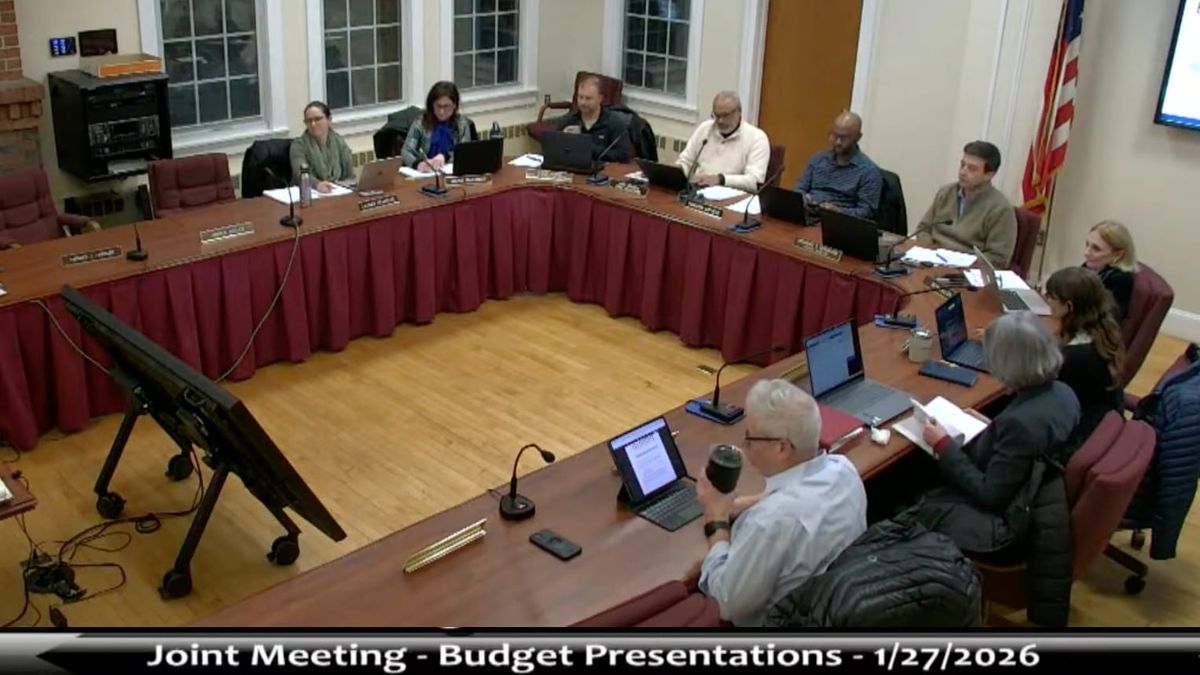
Across the four joint budget meetings of the Board of Selectmen and Board of Finance, town officials heard operating and capital budget presentations from municipal departments, boards and commissions, the Woodbridge School District (grades pre-k through 6), and the Amity Regional School District (grades 7 through 12). The joint sessions were intended to establish a shared baseline understanding before formal budget recommendations are developed.
Beecher school budget emphasizes continuity, deferred capital decisions
At the January 27 meeting, the Woodbridge Board of Education (WBOE) presented its proposed budget, emphasizing alignment with the district’s strategic plan and a focus on maintaining core educational programming at Beecher Road School.
School officials described the budget as advancing existing instructional priorities while continuing to defer major capital planning decisions pending broader community discussions about the school building’s future (see previous reporting on the latest planning by the Beecher Building Committee). Capital requests included items that have appeared in prior plans, but district leaders emphasized that long-term facilities decisions remain unresolved and would require further public engagement.
The presentation also addressed grant funding, enrollment trends, and staffing, with administrators noting that federal grant funding remains an area of uncertainty and that special education services continue to be a significant cost driver. As previously reported, the request totals $19,496,610, representing an increase of $970,755, or 5.24 percent, over current budget spending.
Municipal departments outline operational needs
That same meeting included presentations from a range of municipal departments and boards, including the Police Commission, Animal Control, Building Department, Library, Public Works, Waste Management, and the Thomas Darling House.
Together, these presentations focused on maintaining baseline services, equipment replacement, and routine operational needs. Several departments highlighted aging vehicles, facilities maintenance, and rising costs as ongoing challenges, while stopping short of proposing major program expansions.
Fire apparatus financing brings capital costs into sharper focus
The January 29 meeting turned more squarely toward capital financing, beginning with a detailed discussion of proposed financing options for a new replacement ladder truck for the Fire Department.
Town officials reviewed lease terms ranging from five to ten years, interest rate comparisons from multiple lenders, and the use of a non-appropriation clause — a standard municipal financing provision that makes the contract contingent on future funding being approved through the annual budget process. If funds are not appropriated in a future year, the town would not be obligated to continue the contract.
Fire officials also noted upcoming equipment needs beyond the ladder truck, including radios and air packs expected to come off lease in the coming years, underscoring the cumulative nature of capital obligations.
Amity budget reflects modest growth, enrollment-driven cost shifts
The Amity Regional School District presentation later in the January 29 meeting outlined a proposed budget increase of approximately 2.21 percent overall, with Woodbridge’s share projected to increase by about 2.59 percent. Officials explained that the difference reflects a shift in student enrollment among the three sending towns, with Woodbridge accounting for a slightly larger share of the district’s student population, resulting in a corresponding adjustment to its share of the budget.
District officials emphasized that the proposed increase is driven largely by contractual salary obligations, benefits, and mandated services, while also noting a significant decline in debt service that helped offset other cost pressures. Enrollment across the district was described as stable, with a modest increase not expected to materially affect staffing needs.
Officials also flagged uncertainty around future federal funding levels and unfunded mandates as ongoing risks in the budget outlook. It should be noted that the Amity Board of Education (ABOE) has not yet voted on its FY2027 budget. Under the district’s established process, the proposed budget is reviewed by the Amity Finance Committee (AFC), with further discussion and potential revisions before the full ABOE votes to finalize the proposed budget. Only after board approval does the budget proceed to consideration at a District Meeting and, following that, a referenda in Woodbridge, Orange, and Bethany in early May.
Future Amity capital bond discussed
District officials also discussed planning for a future capital projects bond referendum covering a package of facility and infrastructure upgrades across Amity schools. While the total cost of the proposed projects has been discussed publicly as being on the order of $50 million before state reimbursement, officials emphasized that the scope, timing, and final bonding amount remain under development.
During the discussion, one Selectman cautioned against allowing the relatively modest operating budget increase to obscure the scale of potential capital costs ahead. Referring to the anticipated bond, the member noted that if the current year’s lower budget increase is driven largely by declining debt service, residents should be mindful of what follows, saying she did not want “that low number to be deceptive — at least psychologically — in our budget decision-making,” given the possibility of a large bond in coming years
Other Selectmen, and district officials, acknowledged the concern and noted that expected state reimbursement rates, which could significantly reduce the net cost of any bond, are still being finalized. Any bonding proposal would require voter approval in all three member towns, with costs shared among Woodbridge, Orange, and Bethany based on the district’s enrollment formula.
If approved and bonded, Amity’s capital costs would appear as overlapping debt for Woodbridge — representing the town’s share of debt issued by the regional school district. While separate from debt issued directly by the town for municipal facilities or Beecher Road School, the Woodbridge share of overlapping debt would still factor into the town’s overall long-term debt profile and financial planning. See separate article in the Our Schools section for more on Amity’s facilities and capital planning.
What comes next
With the joint presentation phase complete, the budget process now shifts to internal deliberations. The Board of Selectmen will develop its recommendations, followed by formal review and adjustments by the Board of Finance in the weeks ahead.
A preliminary public hearing on the proposed budget will be held in April, followed by any additional adjustments and, ultimately, consideration at the Annual Town Meeting in May. Throughout this process, elected and appointed officials are tasked with weighing the information presented during these January joint meetings and translating it into budget recommendations that determine the town’s final mill rate — and resulting tax impact for residents.