Election 2025: High Turnout and Tight Finish As Cardozo Is Reelected
Just eight votes separate the candidates for First Selectman according to the preliminary count, requiring a recanvass to be conducted
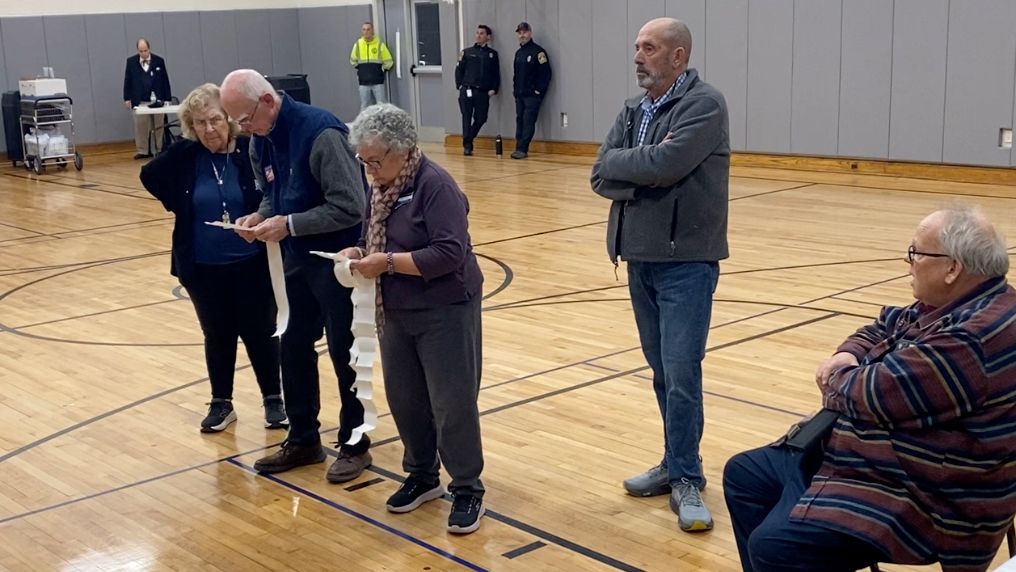
Recanvass concludes at 7 p.m. — confirms the preliminary report of vote totals with no change
See previously reported article, below.
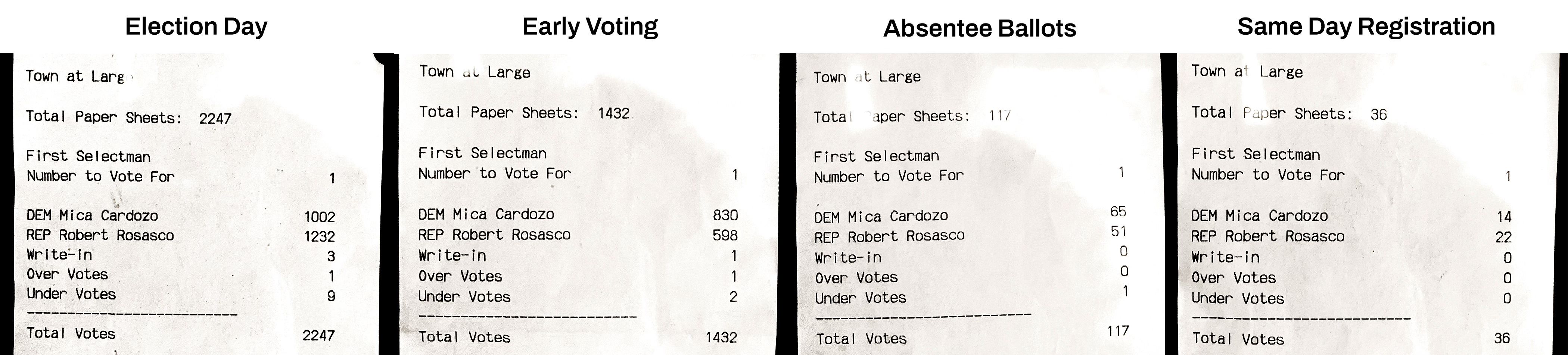
Woodbridge voters turned out in strong numbers on Tuesday, November 4, 2025, casting just over 3,800 ballots (representing about 61% turnout) — the town’s highest municipal participation in recent memory. After the results were announced when polls closed at 8 p.m., it was reported that incumbent First Selectman Mica Cardozo received 1,927 votes to edge out challenger Robert Rosasco who received 1,919 votes.
You can view the full preliminary results as reported on the town website, and view the recording of the announcement itself, below.
Because the preliminary results showed that the race was decided by only eight votes, a recanvass of votes is required by state law C.G.S. § 9-311a. The recanvass was subsequently scheduled for Monday, November 10, beginning at 9:30 a.m. in the Center Building gym.
A preliminary look at turnout by affiliation reflects strong participation across the board:
- Democrats: ~67% turnout, up about 6 points from 2023
- Republicans: ~66% turnout, up by roughly the same amount
- Unaffiliated: turnout jumped nearly 10 points, bringing them to more than half of their registered base and expanding their share of the electorate
Voters not affiliated with a political party now make up a larger share of the total electorate in Woodbridge than before — a decisive factor in such a close race.
The announced totals suggest significant crossover voting. Rosasco received 1,919 votes despite only 723 registered Republicans casting ballots — meaning roughly 1,200 additional votes came from unaffiliated or crossover Democratic voters. In the 2023 race, which saw 3,304 voters participate in the town’s first November municipal election, Cardozo won 1,926 to 1,393, a 58 % to 42 % margin. In 2025, even with Democrats turning out at their highest rate in years, a portion of that participation appears to have split at the top of the ticket. The announced results Tuesday night — 50.1 % for Cardozo to 49.9 % for Rosasco — underscore how evenly divided the electorate has become.
Results from around Connecticut
Across Connecticut, meanwhile, Democrats rode what a CT Insider article published on November 7 described as a “seismic blue wave,” flipping control of municipal governments “from cities like New Britain to small towns like Bethany and from middle-class communities like Ansonia to wealthy ones like Westport” (see full news article by CT Insider “Historic election for CT Democrats flips 25 towns, cities blue”).
Against that backdrop, Woodbridge’s razor-thin margin stands out as one of the closest contests in the state. As another CT Insider article published November 9 reported, “more than 20 Democrats either won open mayoral or first-selectman seats or defeated Republican incumbents,” with Easton the lone exception statewide, where the GOP recaptured the top seat from Democrats by only 6 votes. This race is also subject to state-mandated recanvass, which is scheduled for November 11 (see full news article by CT Insider “What these nine Connecticut towns tell us about the 2025 election”).
Even in communities swept up in the Democratic surge, local finances loomed large. In Bristol, for example, CT Insider reported that newly elected Mayor Ellen Zoppo-Sassu cited property-tax increases averaging 27% as a decisive factor for voters — a sentiment echoed by some voters in Woodbridge confronting rising assessments of their own.
The pattern also appears to have extended to land-use and development issues. In Middlebury, CT Insider noted, petitioning candidate Jennifer Mahr was elected first selectwoman after leading grassroots opposition to a massive warehouse project — which parallels local debate here over issues related to the town’s future growth and development.
Taken together, these outcomes across the state suggest that in some municipalities local concerns carried more weight with voters than national or partisan trends.