BOS rejects draft POCD, reviews final CCW plan
September meeting also featured public hearing on proposed Housing Commission ordinance
The Board of Selectmen’s regular monthly meeting on September 10 covered several items of long-term importance for the town, including two public hearings, a final planning presentation, and continued discussion of the draft of the state-mandated Plan of Conservation and Development (POCD), in addition to routine matters.
POCD Hearing and Action
The continuation of the public hearing on the draft POCD drew strong resident criticism. Speakers described the draft as incomplete, contradictory, and lacking in coordination. Several argued that the draft read less like a plan of conservation and development and more like a “plan of conflict,” setting preservation goals against growth objectives rather than showing how they could be balanced. Others pointed to gaps in process, noting that survey results were not fully incorporated and that the draft had been advanced without adequate review and appropriate incorporation of input from other commissions. Multiple residents called for the plan to be rejected outright and re-written with a more representative process that would include conservation, housing, and economic development voices at the same table.
After considerable debate, the Selectmen voted to formally reject the draft POCD. Two additional motions followed:
- to recommend the establishment of a broad-based committee to work with the Town Plan and Zoning Commission (TPZ) on revisions, and
- to transmit to the TPZ the Selectmen’s compiled feedback documents, together with Conservation Commission input.
All three motions passed unanimously.
In their discussion, Selectmen noted that a potential upcoming revision to the Affordable Housing Plan (see town website for current and proposed AHP documents) and the soon-to-be finalized CCW Master Plan (further information below) might serve as reference points for TPZ in reworking the POCD. With regard to timing of next steps, the Board agreed to forward any additional feedback to TPZ before the end of September to keep the process moving forward.
Hearing on Housing Commission Ordinance
The Selectmen also held a public hearing on a proposed ordinance to establish a Housing Commission to replace the ad hoc Housing Committee. Residents questioned the size and structure of the proposed body, suggested revisions to its stated purpose, and urged that the ordinance guarantee stronger opportunities for public input before future Affordable Housing Plan updates. After hearing these comments, no further action was taken. Next steps on the ordinance are expected to be taken up for consideration at a future meeting.
CCW Master Plan Under Review
Later in the meeting, a representative from consultant agency Cooper Robertson presented the final draft of the Country Club of Woodbridge Master Plan. The document represents the culmination of nearly a year of public engagement that included discussion at seven prior BOS meetings, presentations at two open houses, a public opinion survey, and a series of stakeholder meetings and interviews.
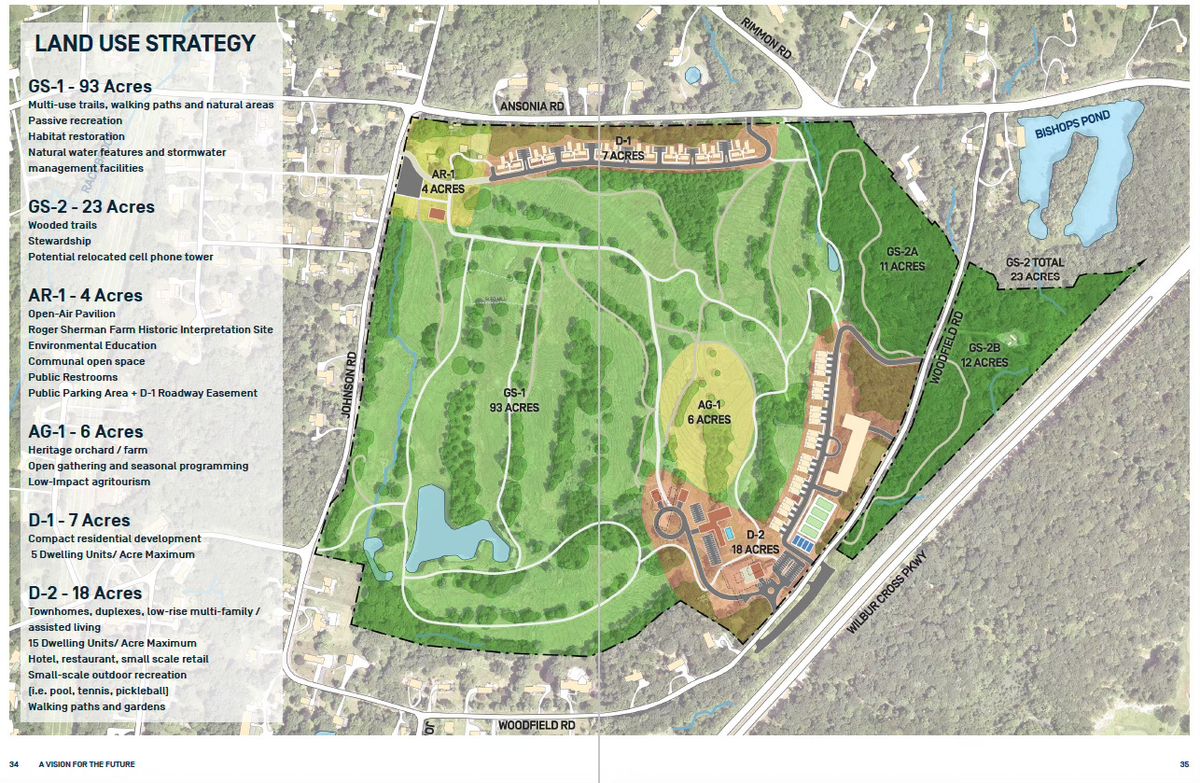
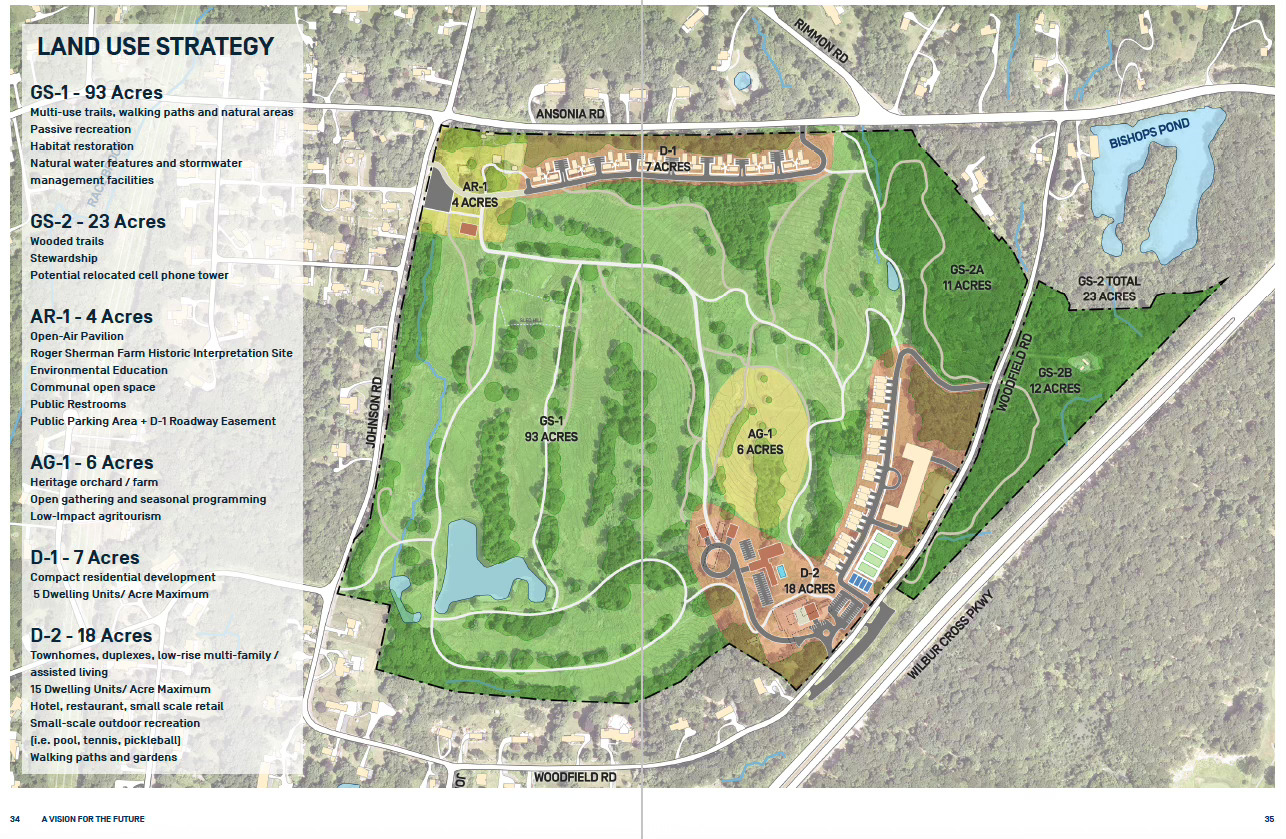
While proposing limited development on the roughly 155-acre parcel, the plan sets aside 116 acres — maintaining “93 acres of meadows, wooded areas, and water bodies with an improved network of both natural trails and paved, accessible paths, as well as 23 acres of more densely forested area with trails.” The proposed development is limited primarily to the area around the former clubhouse on Woodfield Road, which has already been disturbed by past use, with possible development along a stretch of Ansonia Road, an area not previously developed. Also envisioned are areas of small-scale community uses tied to local history on approximately 4 acres near the intersection of Ansonia and Johnson roads – see map, below.
In terms of economics, the report estimates between $1 and $2 million in annual net revenue if 26 acres are developed while 126 acres are retained, remediated, and maintained. The consultants noted this figure depends on the configuration of development parcels and the extent of ongoing ecological restoration investment. A chart in the report presents a six-year implementation timeline (page 48) and underscores that town expenditures and commitments would come in advance of any projected revenues, meaning positive net income to help defray associated service costs may take years to materialize – see chart below.
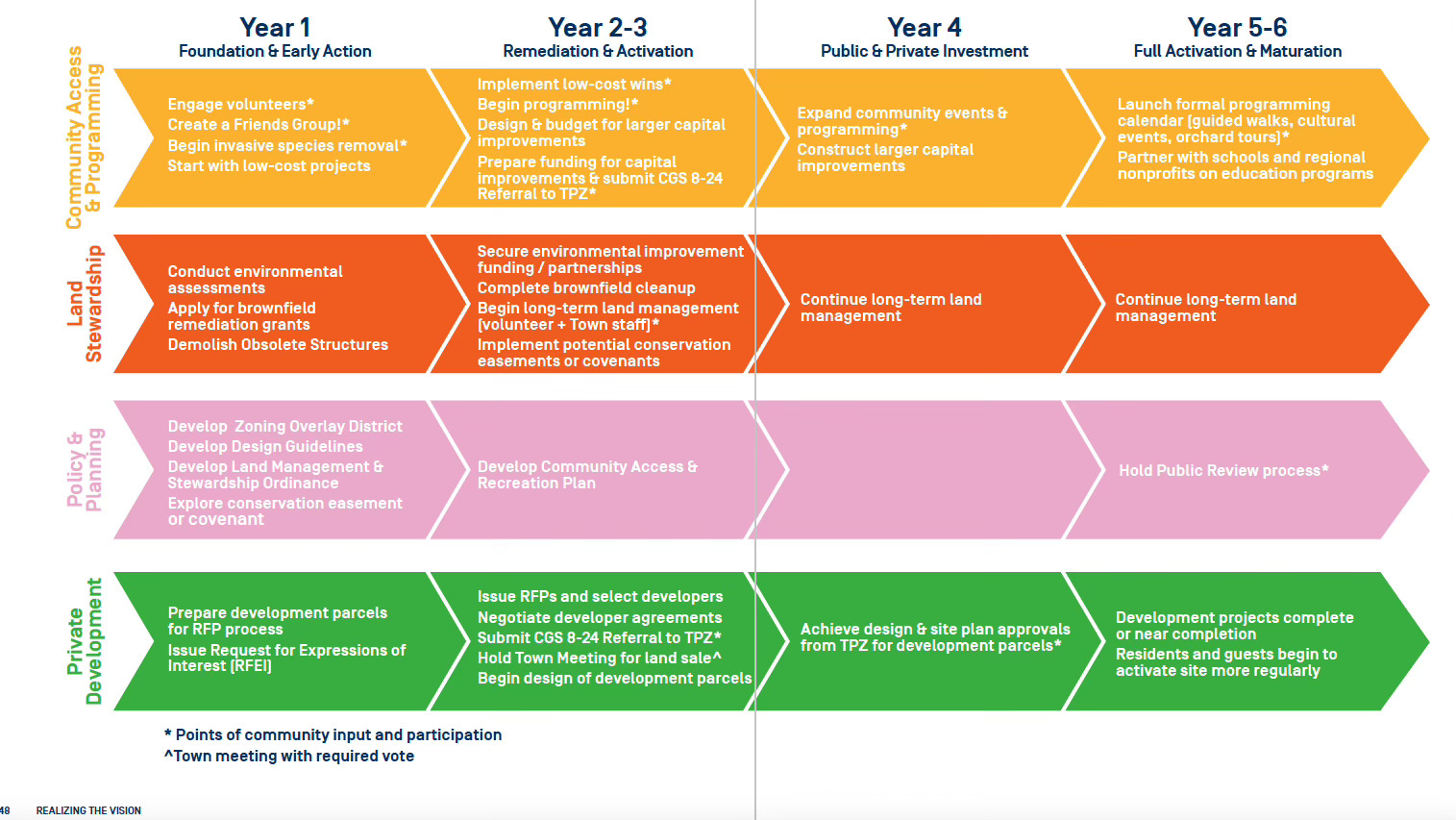
This same chart also identifies formal points of community input during Years 2–3 of implementation: public participation when the Town Plan and Zoning Commission reviews an 8-24 referral, and a required Town Meeting vote before any land sale. This clarification came after legal review by the town attorney, whose memo (page 395 of the 509-page appendix) states there is no Charter authority for a machine-vote referendum on such matters. Instead, sales or leases of town property must be approved at a Town Meeting, with a quorum of at least 100 qualified residents.
It was noted during the meeting that this interpretation introduces an unresolved ambiguity. The 2009 purchase of the CCW property was authorized at the Annual Town Meeting, and a 2011 proposal to sell a portion of the property was rejected by referendum. Both actions were undertaken under advice of counsel at the time, applying the same Charter that is now being read differently. This history underscores the importance of communicating clearly how the public will participate in any future decisions.
Public input earlier in the meeting included concern that the CCW plan did not directly integrate affordable housing into its design. During the presentation by Cooper Robertson, it was highlighted that the plan does briefly mention affordable housing, including in a footnote on a series of graphics starting on page 41 suggesting a minimum of 10% affordable units for any project over ten homes. The consultant explained that the current zoning regulation already requires 12% affordable units, and that any change to 10% — along with any other zoning change for this parcel — would entail creation of a new zoning overlay district. As the property owner, the BOS would need to apply for such an overlay, and TPZ would follow its normal procedures — including public hearings and a formal vote — to decide whether to approve it.
At the conclusion of Wednesday night’s presentation, the Selectmen placed the plan under final review. Any feedback or corrections must be submitted within seven days of the meeting, limited to factual or drafting errors for incorporation by the consultants. It is not yet clear whether the Board will take a formal vote to accept the plan at a future meeting.
As usual, the meeting’s agenda and draft minutes are available on the Town website and the full meeting recording, available on YouTube, can be viewed by clicking below:
Editor’s note: This recap is written by Sheila McCreven in her role as editor of the Chronicle. Sheila is also an elected member of the Board of Selectmen (her term ends December 31, 2025). See the Editorial Note on Government Coverage on our About page to learn more.