Board of Selectmen hold special meeting; act on appointments, charter revision, and other items
First meeting of the newly-elected BOS sets January off to a quick start.

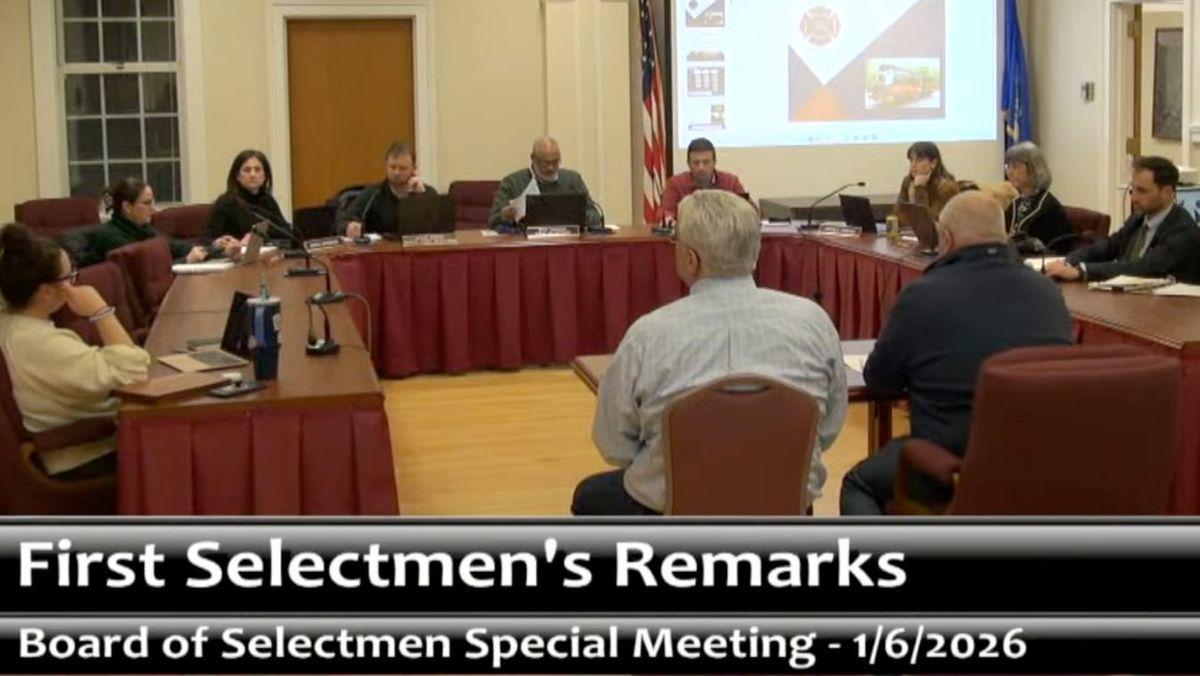
First meeting of the newly-elected BOS sets January off to a quick start
The Woodbridge Board of Selectmen convened a special meeting on January 6 to take up a series of organizational, governance, and policy matters at the outset of the new Board’s term. After the meeting began with brief welcoming remarks from First Selectman Mica Cardozo, the agenda turned to an abbreviated set of items including a fire apparatus review, appointments of town officials and volunteers, initiation of a charter revision process, discussion of official email access for Selectmen, and confirmation of the Board’s 2026 meeting schedule.
Fire apparatus planning and capital signaling
Fire Chief Sean Rowland presented an overview of the department’s fire apparatus planning, focusing on the age, condition, and anticipated replacement timelines for major vehicles. The discussion emphasized that fire apparatus purchases now involve extended lead times and rising costs, making years-ahead planning essential.
Board members asked clarifying questions about replacement cycles and how future apparatus needs would be reflected in the town’s broader capital budgeting process, noting that early awareness is critical even when no immediate funding decision is before the Board. While no action was taken, the presentation functioned as an early signal that substantial capital expenditures are likely in coming years — illustrating how major infrastructure needs enter the policy pipeline well before they appear in the budget.
Appointments of town officials and membership on boards, commissions, and regional bodies
The Board next turned to appointments, acting on proposed appointments of town officials, town boards and commissions, and regional entities where Woodbridge holds representation. These appointments are one of the Selectmen’s most consequential responsibilities through which the Board determines who exercises regulatory authority, advises on policy, and represents the town in regional decision-making. Read full details of the appointments in a companion article: Selectmen tackle biennial board and commission appointments.
While most appointments were approved as presented after brief discussion, a few were deferred for action at a later date. Discussion included questions about how minority-party representation rules apply to alternate members of boards, and how the removal process works in the event that a resignation has not been received. Town counsel was asked to clarify applicable rules.
At multiple points, the discussion underscored how heavily the appointment process relies on informal knowledge and nominations that are vetted outside the Board's direct involvement, rather than on any clearly articulated, written framework accessible to the public or to newly seated Board members.
Initiation of the charter revision process
The Board also voted to initiate a charter revision process, formally setting in motion the procedural steps required under state law and the town charter. The action authorized the creation of a seven-member Charter Revision Commission charged with reviewing the existing charter and proposing potential amendments for voter consideration.
A town charter functions as a municipality’s foundational governing document. Changes to the charter can affect how authority is allocated, how boards are structured, and how residents participate in governance. Read additional details of the process in a previous article: What Is Charter Revision.
During the discussion, Board members emphasized that the vote did not endorse any specific charter changes. Instead, it was framed as a threshold action to open a process. References were made to the importance of public input and transparency, but details about how that engagement would occur were not developed.
Notably, the discussion did not include any indication of who might be nominated to serve on the Charter Revision Commission, nor was there discussion of desired qualifications, expertise, or representational balance. There was also no indication that alternative commission structures, appointment methods, or vetting processes had been evaluated prior to the vote.
As a result, while the Board voted unanimously to initiate the process, key questions about who will shape it — and by what criteria — were left unresolved for now. Because charter changes ultimately require voter approval, the structure of the review process itself will likely play a significant role in public confidence in the process.
Consideration of town-issued email addresses for Selectmen
Following a discussion that addressed cost, administrative complexity, and cybersecurity considerations, the Board voted to not create town-issued email accounts for Selectmen. This action reverses a vote taken by the previous Board to initiate the creation of such town-issued addresses; however, those accounts were not ultimately issued. Selectmen cited concerns about expanded IT oversight and the cost of additional accounts, estimated at approximately $33 per month per user, and opted to continue the existing practice of using personal email accounts for communication about Board business and while accessing town-managed systems. Under Connecticut law, emails related to town business are public records regardless of the account used.
During the discussion, it was acknowledged that email addresses issued through a centralized system would provide clearer oversight, enforce uniform cybersecurity controls such as secure password requirements, and reduce reliance on individual practices. At the same time, there was brief mention that continued use of personal email credentials to access shared drives maintained by the Town and to conduct other official interactions may increase long-term legal and security risk. As a result, the Board’s decision reflects a policy choice shaped largely by cost considerations and informal assumptions rather than by documented best practices, expert input, or a comprehensive assessment of cybersecurity and public-records risk.
Confirmation of 2026 meeting dates
To conclude the meeting, the Board voted to confirm its regular meeting schedule for calendar year 2026, establishing dates for the year ahead. The schedule sets the framework for the Board’s regular business meetings and provides advance notice to residents interested in attending or following Board proceedings — visit the Town website for further information.
Looking ahead
The January 6 special meeting addressed a wide range of governance issues — from routine appointments to decisions with long-term structural implications. Across multiple agenda items, the new Board acted at its first meeting to move processes forward while leaving some significant structural and procedural questions unresolved for the time being. As these matters return to the Board’s agenda, the clarity of next steps and criteria is likely to shape both outcomes and public confidence.
The next meeting of the Board is scheduled for Wednesday, January 14, 2026 and a meeting notice will appear in advance as a listing on the town website’s Agenda Center page. BOS meetings are open to the public and streamed live on the Town’s YouTube channel, WGATV79. Click below to watch the full recording of the January 6 meeting.