Board of Selectmen Discuss Tax-Relief Options and Affordable Housing Plan
Meeting Jointly with Finance, Selectmen Consider the Broader Implications of Tax Exemptions, Moving Two Options to Public Hearing
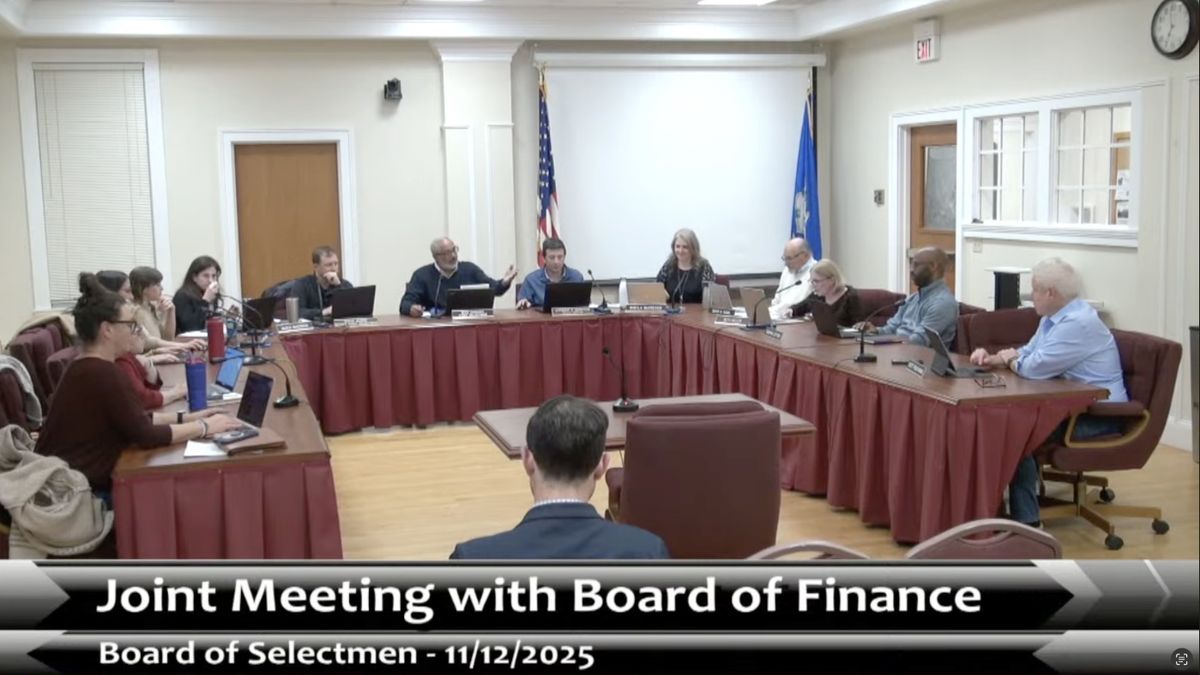
The Board of Selectmen covered a series of routine topics during its regular meeting on November 12 beginning at 5:00 p.m. and after a brief recess reconvened at 7:00 p.m. for a joint session with the Board of Finance to review several matters affecting the town’s long-term financial planning and tax-relief programs.
The session opened with brief remarks from the First Selectman addressing the recently concluded town election, followed by an update from Woodbridge School District Superintendent Christopher Montini covering enrollment, programming, and facilities issues. The Board then entered Executive Session to receive an update related to the ambulance service contract solicitation; no action was taken upon returning to public session.
Human Services provided an update on a state grant-funded Recreation Room renovation project in the Center Building and the Selectmen voted to authorize the project to move forward as previously described in a presentation earlier in the year. The Consent Agenda, including minutes and tax refunds, was unanimously approved. Public Comment then touched on issues including the town’s Affordable Housing Plan (AHP).
The Selectmen then also discussed the latest draft of suggested updates to the Woodbridge AHP, recognizing that the CT General Assembly was still debating major changes to statewide housing law during the special session called by the Governor. The board noted that several provisions under discussion as part of House Bill 8002 could directly affect the town’s AHP — including a possible option for municipalities to adopt a regional plan (for Woodbridge, this would be SCRCOG).
According to the Office of Legislative Research Bill Analysis, one proposed section of HB-8002 states:
“Replaces current law’s requirements on municipal affordable housing plans (CGS § 8-30j) with a new framework in which municipalities generally decide whether to opt into a regional COG-made plan or develop their own plan for increasing the number of affordable deed-restricted units;…”
Because the bill had not yet passed and key details remained undetermined as the Selectmen were meeting, they agreed to wait for final legislation before revisiting the topic in December once more definitive guidance is available. It was also noted that any new state law on Housing might also impact the ongoing update of the town’s Plan of Conservation and Development.
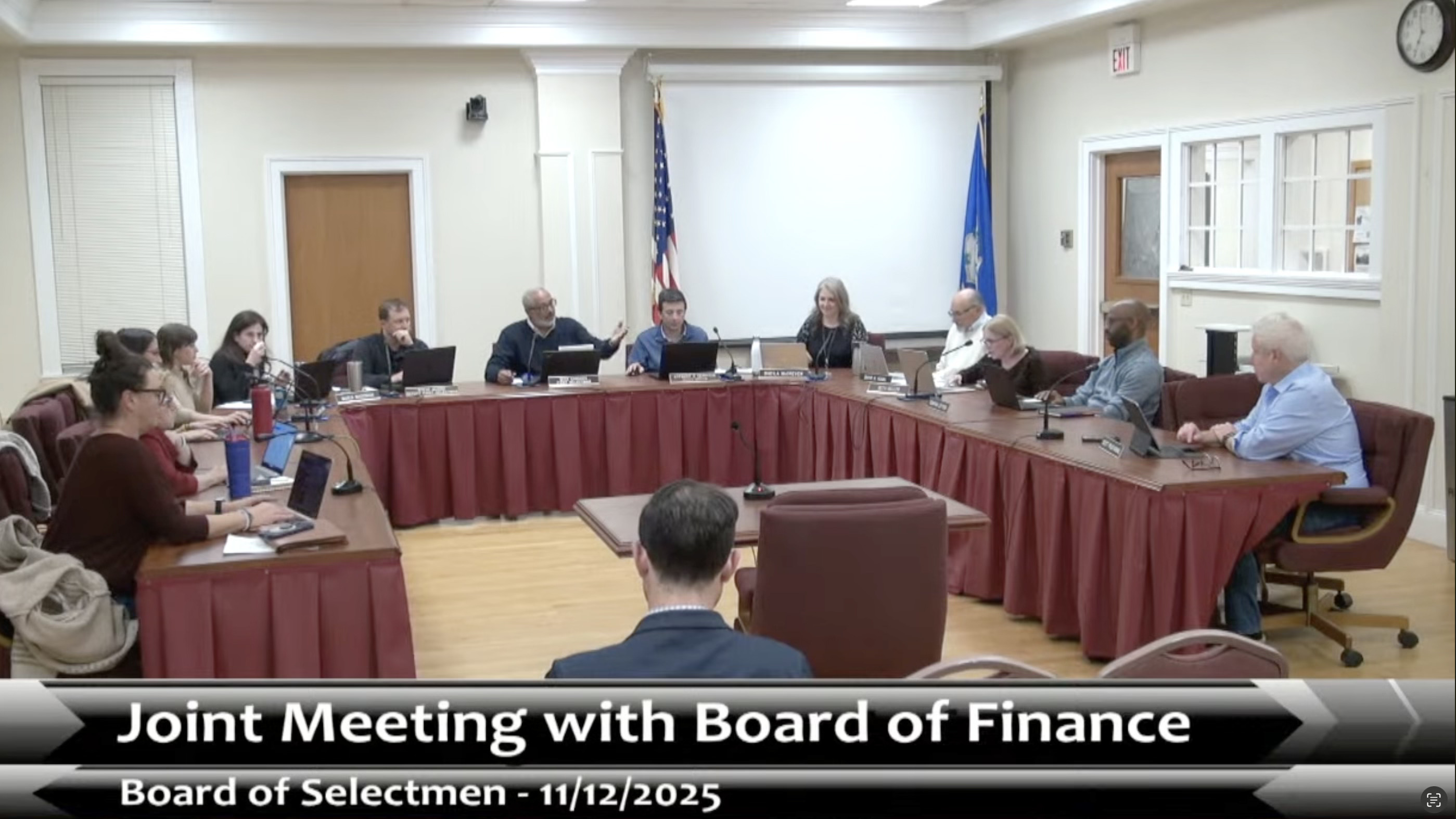
Joint Meeting of the Boards of Selectmen and Finance
The jointly convened boards received an update on the status of the Warner Elderly Housing on Lucy Street and discussed a proposed tax-abatement ordinance intended to help preserve affordability should the Warner housing complex be converted by a new owner to become 100% affordable housing. The ensuing conversation included questions about how such an agreement might be structured, enforced, and incorporated into the existing land lease the town currently holds.
With the Town Attorney, the Selectmen and BOF members also reviewed state statutes that allow towns to offer tax relief for fully affordable developments and it was noted that, under current law, any meaningful enforcement of building maintenance or rent-related issues would require establishing either a local or regional Fair Rent Commission — an option that might become more feasible through SCRCOG if new state legislation passes. No action was taken on the topic of the Warner Housing complex, pending further information.
The Board then reviewed proposed updates to the town’s Relief for Elderly and/or Totally Disabled Homeowners program and voted to set a public hearing for December 10 to consider updates to this ordinance. The draft changes would raise the income limits by replacing a long-used state calculation with HUD’s Area Median Income standard, which adjusts annually and provides a more responsive and accurate measure of need — one that shifts with housing costs, incomes, and other economic changes affecting local seniors and residents with disabilities. The proposal also increases the tax-credit amounts, expands eligibility to include more households, and raises the program’s total annual cap from $190,000 to $300,000. Under the draft, the credit levels would be fixed at $1,600 and $1,320, with prorating required only if total applications exceed the cap and the BOS and BOF do not act to allocate additional funding above the annual cap.
The boards also reviewed proposed updates to the town’s existing property tax Exemption for Veterans with a 100% service-connected disability. Under a new option recently made available by the state, the ordinance can be expanded to exempt not only the dwelling but also up to two acres of the land on which it sits. The Selectmen then voted to set a public hearing for December 10. The draft amendment would adopt this expanded exemption and establish December 8, 1941 — the date of U.S. entry into World War II — as the historical eligibility cutoff for surviving spouses, seeking to ensure that all remaining surviving spouses of veterans are covered.
Finally, the joint meeting took up the topic of introducing a possible Homestead exemption. This would allow the town, within the limits of state law, to reduce the taxable assessment on a homeowner’s primary residence — providing targeted relief to full-time residents rather than to rental or commercial properties. The discussion focused on how an exemption could be designed, its potential fiscal impact, and whether it could help cushion the effect of recent revaluation shifts on long-time homeowners. The boards referenced New Milford’s recently enacted program, which was adopted in early fall as the first such program in the state. According to an FAQ document on the New Milford website, the application deadline there is December 31, allowing the town to determine how much relief to grant before January 31, when the grand list — on which FY27 tax bills will be based — is due.
It was noted that, for Woodbridge, it appears to be too late in the calendar year for a Homestead exemption to become effective for this budget cycle as, in order to implement, the Selectmen would first need a town-specific ordinance drafted and introduced. The Board would then need to set a public hearing, hold that hearing, and subsequently vote to enact the ordinance. Because any new ordinance takes 30 days to become effective, this would likely leave too few days to allow residents a reasonable amount of time to learn about the program and submit applications before the January 31 grand list deadline to affect the October 1, 2025 Grand List which determines next year’s tax bills.
It was noted that if the town pursues a Homestead exemption in the months ahead, the likely earliest possible impact would be on FY28 tax bills (issued July 2027). It was also emphasized that the discussion so far was exploratory only, and would require additional analysis of budget impacts, eligibility rules, and how the exemption would interact with existing tax-relief programs as well as the town’s overall economic development plans.
For the remaining tax-relief concepts under review — including the municipal motor vehicle option and other potential adjustments — the Selectmen agreed to await further consideration by the Board of Finance at its November 20 meeting before taking any action. The consensus of the Selectmen leaned toward not moving forward with additional measures beyond the two items already scheduled for public hearing in December, unless the Board of Finance recommends otherwise.
The joint meeting was adjourned shortly after 9:00 PM. The Selectmen’s next regular meeting is scheduled for Wednesday, December 10, 2025, at 5:00 p.m. in the Town Hall Central Meeting Room. As usual, a meeting notice will appear in advance, as a listing on the town website’s Agenda Center page. BOS meetings are open to the public and streamed live on the Town’s YouTube channel, WGATV79. Click below to watch the full meeting recording.
Editor’s note: This recap is written by Sheila McCreven in her role as editor of the Chronicle. Sheila is also an elected member of the Board of Selectmen (her term ends December 31, 2025). See the Editorial Note on Government Coverage on our About page to learn more.