Board of Finance advances FY27 budget with lower spending increase, higher tax impact
Tax levy set to rise 4.93% despite 1.93% spending increase, driven largely by $1.67M drop in state aid

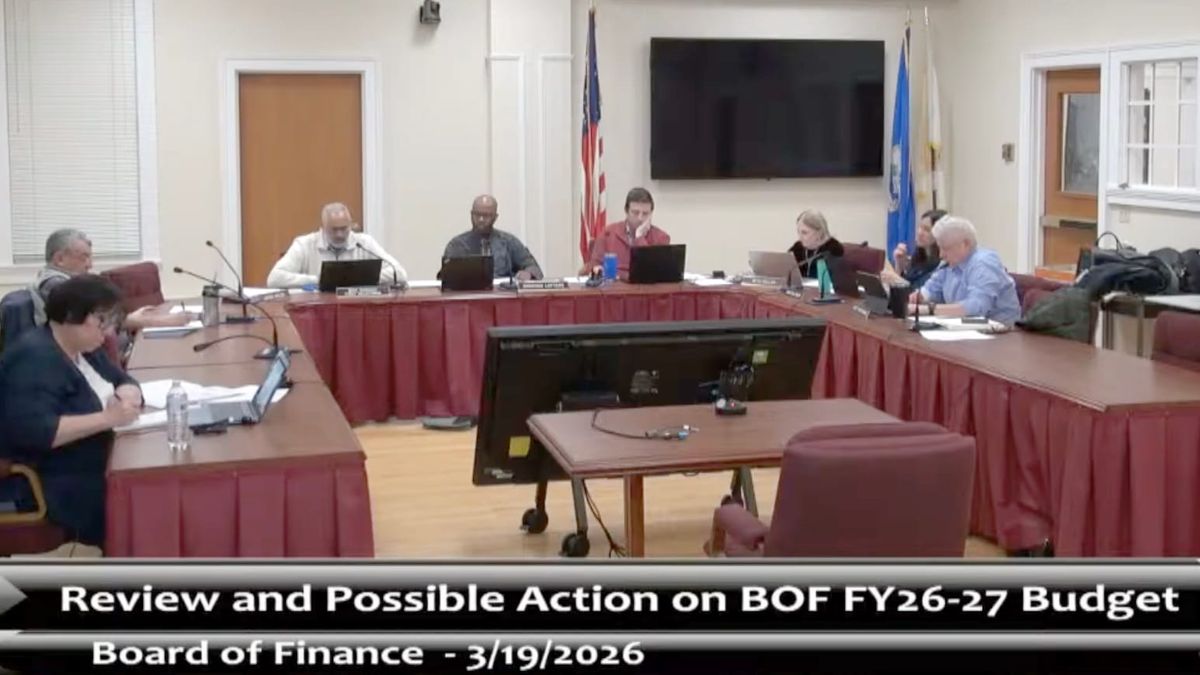
At its March 19 regular meeting the Woodbridge Board of Finance (BOF) voted to recommend a revised FY2027 operating and capital budget to the Preliminary Budget Hearing, reducing the proposed spending increase from earlier Board of Selectmen levels while still projecting a higher increase in the tax levy.
After more than two hours of budget discussion at the meeting, the BOF voted to recommend a 4.93% increase in the amount to be raised by taxes, which will result in the town’s mill rate rising from 32.62 to 34.02 for FY2027 — an increase of 4.29% — while the mill rate for motor vehicles will remain at the capped 32.46 rate required by state law.
While the proposed spending increase of 1.93% is relatively modest, the largest driver of the tax increase appears to be the sharp reduction in state revenue — estimated at $1.67 million — primarily related to changes in motor vehicle tax reimbursement (see previous article for details).
BOF trims spending from BOS plan, but increases tax impact
The BOF’s recommendation represents a notable shift from the proposal advanced by the Board of Selectmen at its February 17 meeting (see previous article). At that time, the Selectmen voted 4–2 to forward a budget reflecting an overall 4.84% increase in the amount to be raised by taxes over the current fiscal year.
While the Board of Finance reduced the proposed spending increase to 1.93% — identifying significant savings in areas including employee benefits, as well as other operating adjustments — the recommended budget results in a 4.93% increase in the amount to be raised by taxes, reflecting changes to both spending and revenue assumptions.
While reducing spending, the Board also lowered projected revenues — eliminating anticipated income from building permit fees and any potential public property sale — a combination that ultimately increases reliance on the property tax base.
Removal of anticipated property sale and fee revenue
The Board reduced projected revenue associated with the proposed apartment development at 804 Fountain Street, reflecting concerns that the project may be delayed due to potential appeals (see March 2 Letter to the Editor for details). Rather than relying on those revenues in the upcoming fiscal year, the Board adjusted the budget to reflect a more conservative assumption.
The Board also removed approximately $500,000 in anticipated revenue from the potential sale of public property, which had been included in the BOS-recommended budget plan.
During the meeting, BOF members expressed concern about relying on one-time revenue sources to support ongoing operating expenses, noting that such an approach could create structural imbalances in future budgets.
To offset that change, the Board also removed a previously discussed capital project related to water damage repairs in the lower-level Town Clerk offices at Town Hall. The project was identified as appropriate for funding through a potential property sale, consistent with finance policy governing one-time revenues.
Board members indicated that these linked items could be revisited outside the annual budget process if a property sale were to move forward during the coming year. At that point the proposed sale and any related expenditures would be subject to separate approval, including a potential Town Meeting.
Vote highlights role of declining revenue in tax impact
The Board voted 3–1, with one member absent, to recommend the budget to the Preliminary Budget Hearing, with total expenditures set at $62,277.237, non-tax revenue at $4,924,157 and a total of $57,353,080 to be raised by taxes. BOF member Scott Prud’homme voted in opposition to the motion.
Compared to the current year, the recommended budget reflects:
- 1.93% increase in expenditures
- 4.93% increase in the amount to be raised by taxes
- A mill rate of 34.02 for real estate and personal property, a 4.29% increase over the current rate
- A mill rate of 32.46 for motor vehicles, 0% increase over the current rate
Although the proposed budget increases spending by less than 2%, the projected mill rate would rise by more than twice that amount, reflecting revenue pressures rather than spending growth alone.
A key factor is the projected decline in state motor vehicle tax reimbursement following last year’s revaluation, which lowered Woodbridge’s mill rate and reduced its eligibility for aid under the state formula. As a result, even modest increases in spending now require a larger share of funding to come from local property taxes.
The proposed increase in the mill rate for FY2027 — returning to a level above the motor vehicle cap, as had been the case for several years prior to revaluation — may restore some of that state aid in a future year, assuming the state reimbursement formula remains unchanged.
Following the vote, discussion continued, with Prud’homme asked to clarify the concerns behind his opposition. In response, he emphasized his discomfort with not having enough information to fully understand how certain budget decisions were being structured. He referenced discussion earlier in the meeting focused in part on staffing and program costs associated with the proposed Community and Cultural Center, questioning how those costs are reflected in the budget, particularly where responsibilities are shared across positions and funding sources. Prud’homme also pointed to tradeoffs between competing priorities, including funding for public safety needs.
The discussion around staffing also reflected a planned restructuring of town administrative roles following the announced retirement of Administrative Officer and Director of Finance Anthony Genovese. Under the proposal, the combined position would be split, with Genovese expected to continue part-time in the finance role while the Board of Selectmen seeks to hire a full-time Administrative Officer. It had been noted that a proposed three-year grant may support portions of this restructured staffing model.
Prud’homme said, “I’m kind of watching the shells going, it’s all just conversation. I don’t have numbers in front of me to say, here’s how much the grant is, now we’re thinking the administrative officer might be a little more expensive so we better park a little over here, half of Tony’s role, then a communications person, a portion for that. I don’t want to make this all about the community center.” He indicated that the allocation of costs across multiple line items made it difficult to determine the full financial impact of the proposals.
Other members agreed that further detail should be provided as the process moves forward and expressed interest in reaching broader agreement before the budget is finalized.
The Board also discussed the longer-term impact of projects included in the town’s six-year capital plan, including how those investments may affect future debt levels and borrowing needs. Members noted that several major items — including school and public safety facilities — remain subject to further refinement, and indicated that additional analysis and modeling will be needed to better understand their potential impact on future budgets, including any implications for the Town’s Aaa bond rating.
Next steps
The Board of Finance’s recommendation will be presented at the Preliminary Budget Hearing on April 28, where residents will have an opportunity to review and comment on the proposal. After the hearing, the BOF may consider further adjustments before making a final recommendation that will go to the Annual Town Meeting in May for approval.
BOF meetings are open to the public and streamed live on the Town’s YouTube channel, WGATV79. Click below to watch the full recording of the March 19, 2026 meeting.