Amity BOE trims budget proposal to 1.2 percent increase
Board also considers schedule changes at middle schools and hears public comments from students with AI policy concerns

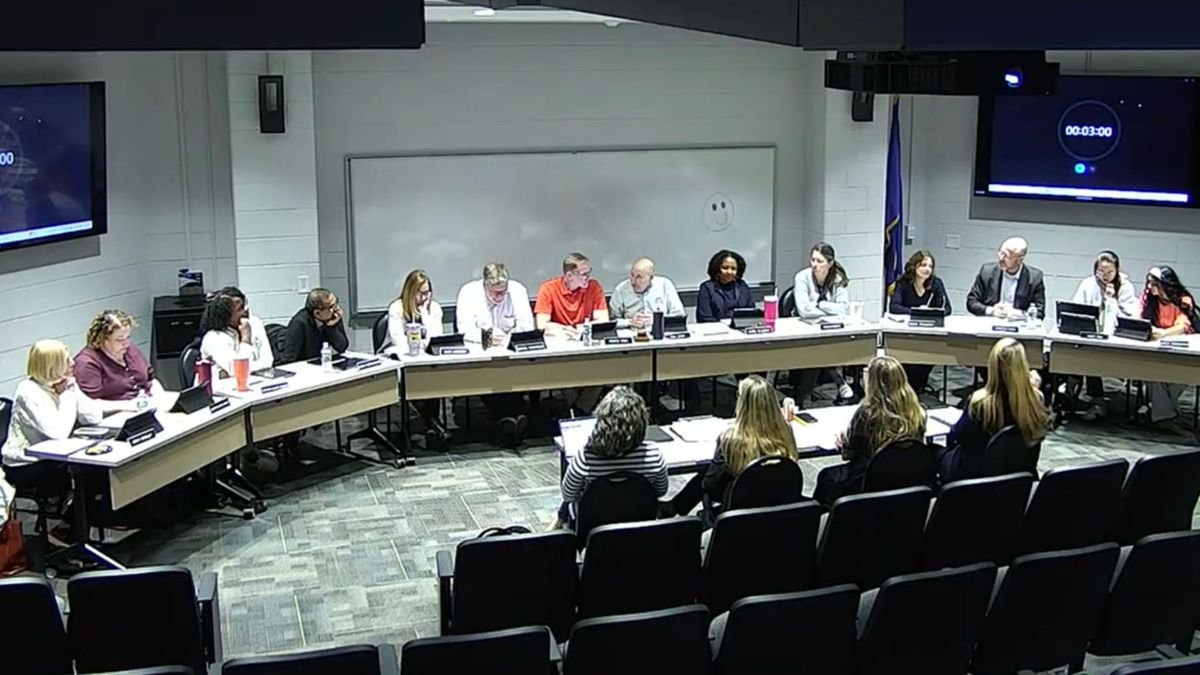
At the March 9 meeting of the Amity Regional Board of Education, three issues — AI policy, scheduling authority, and the district’s budget proposal — dominated the evening’s discussion.
The ABOE heard public comments from students regarding the district’s use of artificial intelligence tools, reviewed newly revised proposed changes to the middle school schedule, and approved its operating budget after trimming the superintendent’s proposal.
The motion that emerged as a compromise to pass the budget — aimed at addressing recurring year-end surpluses — was approved by a vote of 9 in favor with three abstentions and one member absent. It reduced the planned budget increase from 1.35 percent to 1.2 percent, lowering the district’s total spending by roughly $87,000 compared with the superintendent’s revised proposal presented earlier in the meeting.
Students raise AI privacy, cost, and transparency concerns
The meeting opened with discussion of whether the district should develop a detailed policy governing artificial intelligence use in Amity schools. Superintendent Jennifer Byars noted that the district currently relies primarily on guidelines rather than a formal policy, explaining that the technology is evolving rapidly and guidance has been updated frequently as AI tools change.
The policy discussion followed a lengthy public comment period in which several students raised concerns about the district’s use of AI tools. A central theme in the comments involved the distinction between grading and assessment, with students warning that AI-generated evaluations could introduce bias or inaccurate judgments, particularly if automated tools were used to score or review assignments. One student described an instance in which an AI-generated result was flagged by a student as incorrect and later corrected, arguing that such examples illustrate the risks of relying on automated systems in academic evaluation. Students urged the board to ensure that final assessment decisions remain the responsibility of educators.
Students also questioned whether the district should be investing in AI tools at all, raising transparency and oversight concerns about how widely the technology may already be used and arguing that administrators and teachers are highly trained professionals who should not need AI assistance for routine work. One student said attempts to determine the district’s spending on AI licenses initially produced incomplete answers, and that a Freedom of Information request later revealed total spending of $19,216.51 across multiple products, rather than the roughly $11,000 figure previously cited. Students also asked about data privacy provisions in vendor agreements, including where student data might ultimately be shared and how it would be protected.
Board members acknowledged the concerns and discussed possible guardrails that could be incorporated into a future policy, including prohibiting AI-generated grading, requiring disclosure when AI tools are used, exploring whether students should have the ability to opt out of certain AI uses, and establishing a clear and accessible process for students to report concerns or potential problems with AI tools used in their coursework. One board member cautioned that opt-outs may be difficult to implement because AI functions are increasingly embedded in commonly used software platforms such as Microsoft products and design tools like Canva.
After discussion, the board voted to refer the issue to its Policy Committee, which will review the topic and return to the full board with a recommendation at a future meeting.
Proposed middle school schedule changes
The board then turned to another topic on its agenda to review a new proposal for redesign of the middle school schedule. Administrators noted the change was intended to increase elective options and better align the middle school rotation with the high school schedule.
Administrators explained that the revised proposal would maintain the current eight-period structure with 42-minute classes while introducing a four-day rotation similar to the high school model. The changes would also expand language offerings by introducing French alongside Spanish and Chinese, which administrators said would give students additional language options earlier in their academic careers.
The change, administrators suggested, could give the district greater flexibility in how teaching staff are deployed across the secondary grades, for example making it possible for a high school teacher to cover a class at one of the middle schools to address a scheduling gap.
The possibility of sharing staff across schools, however, prompted board members to ask how such schedule changes might affect existing teaching positions. Administrators said implementing the proposal could require adjustments to language teaching assignments across the district’s two middle schools, potentially replacing one Spanish position with a French position while allowing some language teachers to serve both schools.
Several board members raised questions about whether such changes could lead to layoffs if staffing levels were reduced. Board vice-chair Patrick Reed cautioned that eliminating positions could create challenges. “World language is a priority shortage area,” Reed said, adding that if the district were to lay off a language teacher, it might later prove difficult to rehire for the position.
The discussion also turned to the intertwined roles of the superintendent and the Board of Education under the teachers’ union contract, particularly when staffing reductions are involved. Under the contract, layoffs — often referred to in education as a reduction in force, or RIF — are carried out administratively by the superintendent but are typically driven by budget decisions made by the board.
One board member noted that if positions are eliminated as a result of board budget decisions, the superintendent would ultimately be implementing a policy choice made by the board. “If staff is reduced as part of this process, the superintendent will say the board chose to reduce staff,” the member said, arguing that the board should be explicit if it intends to make a decision with staffing consequences.
That concern led several members to argue that the Board of Education — rather than the superintendent — should explicitly authorize schedule changes that could affect staffing levels. During the discussion, board member Donna Schuster cited Connecticut General Statutes § 10-220, which outlines the duties of local and regional boards of education.
The statute includes language stating that boards are responsible for maintaining public schools and ensuring that students have an appropriate learning environment, including adequate staffing, materials, and facilities. A motion was introduced that would have required board approval for schedule changes tied to staffing implications, but the proposal did not pass. Several members indicated the issue is likely to return for further discussion at a future meeting.
Board trims proposed budget mindful of recurring surpluses
Later in the meeting, the board approved its proposed operating budget for the coming fiscal year after making a reduction intended to address concerns that have surfaced about recurring year-end surpluses.
After a brief presentation by Byars detailing where she was prepared to further tighten the budget from her earlier proposal of a 1.53 percent increase over the prior year, the board considered a motion to approve the revised proposal with an increase of 1.35 percent.
Board treasurer Meghan Rabuse then introduced a friendly amendment proposing that the budget increase be limited to roughly 1 percent, with about $200,000 removed from the superintendent’s proposed spending plan.
Rabuse argued that the adjustment could come from two areas of the budget that have consistently produced large surpluses in recent years: the salary line item and purchase services. She cited data showing that the salary line alone has generated surpluses of more than $600,000 in several recent years, even when earlier projections suggested smaller year-end balances. Rabuse said these lines are among the least volatile portions of the budget and therefore should not consistently produce large surpluses.
Board chair Paul Davis, however, defended the superintendent’s proposal, noting that the administration had already worked to bring forward what he described as one of the lowest budget increases the district has presented in years.
Board member Christian Young, who supported Rabuse’s amendment, countered that the unusually small percentage increase this year is partly the result of a one-time drop in the district’s debt service payments — the annual cost of repaying bonds issued for school construction and other capital projects. Without that temporary reduction, Young said, the increase over last year’s spending would appear significantly higher — “actually closer to 4 percent.”
His comments highlighted a concern expressed by some local officials that the relatively small percentage increase — without the context of a one-time reduction in debt service — could give a misleading impression of the district’s underlying operating cost growth.
Young and other members emphasized that the goal of Rabuse’s amendment was not to eliminate programs or reduce staffing, but to improve the accuracy of the district’s budget projections and reduce recurring surpluses.
After this discussion, the board voted on Rabuse’s amendment to set the budget increase at 1 percent, and the amendment received enough support to become the new main motion before the board. Upon further discussion, however, Davis allowed board member Jennifer Jaquet to introduce another friendly amendment to adjust the increase from 1.0 to 1.2 percent.
Several members stated their support for this, describing it as a compromise that acknowledges concerns about surplus while maintaining the district’s educational programs and avoiding staff reductions. Young said even a relatively small reduction like this sends a signal to taxpayers that the board is paying attention to surplus levels and is willing to take steps to decrease them.
The board then approved the revised 1.2 percent increase on a roll-call vote of 9 in favor, none opposed, with three abstentions and one member absent.
Approved budget slightly reduces town contributions
The board’s compromise vote to reduce the budget increase from 1.35 percent to 1.2 percent lowers the district’s overall spending plan by approximately $87,147 compared with the superintendent’s proposal, bringing the district’s proposed budget total to $58,806,307. Because Amity costs are allocated among the three towns using a student enrollment-based formula, the change slightly reduces each town’s projected contribution by different amounts.
An analysis based on details presented earlier in the meeting related to the request for a 1.35 percent increase, shows that Woodbridge’s share of the approved 1.2 percent increase will decrease by about $30,342 compared with the earlier projection, bringing its projected contribution to approximately $20,474,907 for 2026–27. Based on the recalculated figures, this represents an increase of about $332,867 — or roughly 1.65 percent — over Woodbridge’s contribution in the current fiscal year.
The proposed Amity budget will next move to the district’s annual public hearing on April 6, where residents of Bethany, Orange, and Woodbridge will have an opportunity to comment before the ABOE votes on adopting the final spending plan. Following board approval, the budget is expected to proceed to the district-wide budget referendum on Tuesday, May 5, where voters in the three towns will decide whether to approve the proposal.
Click below to watch the full recording of the March 9, 2026 meeting of the ABOE on the district's YouTube channel.